
On August 6, the Commerce Department’s Bureau of Industry and Security published a notice proposing Section 232 tariffs on fourteen more steel, aluminum, and copper derivative products. Shipping containers are not on the list. Self-propelled cranes, mobile lifting frames, straddle carriers, and several classes of trailers and semi-trailers are. The comment window closes August 27, and if you’re planning a container purchase this fall, that distinction matters more than it sounds.
Here’s why: the box is only half of what you pay for. The other half is the equipment that hauls it and sets it. For most buyers shopping used shipping containers this year, delivery and placement is the second-largest line on the invoice — and it’s the line this proposal touches. What follows is what the notice actually says, what it does and doesn’t cover, and how to think about your fall timeline before the rulemaking closes.
What Washington Actually Proposed
The August 6 Federal Register notice asks for public comment on adding fourteen derivative articles to the scope of Section 232 duties on steel, aluminum, and copper. The list is eclectic — aluminum powder, brass wind instruments, floor safes, welding machine parts, fire extinguishers, heat exchanger components — but three entries sit directly in the container supply chain.
Self-propelled cranes, mobile lifting frames, and straddle carriers are proposed for inclusion, with rates varying by country of origin and how the equipment was manufactured. Tanker trailers and semi-trailers, plus several other trailer classes, would generally fall under the 25% rate set in the April proclamation. Agricultural self-loading and self-unloading trailers would face 15%. Filled steel containers holding propane, oxygen, or propene would face 50% on the value of the cylinder itself, not the chemical inside — a category that has nothing to do with intermodal boxes despite the shared word.
That last point is worth saying plainly, because it’s already being garbled online. Intermodal shipping containers are not in this proposal. If you see a listing or a sales pitch this month claiming a new 50% tariff is about to hit the container you’re buying, that’s either confusion or a pressure tactic. The 50% figure in the notice applies to propane and oxygen cylinders.
The broader context is that Section 232 has been widening all year. The April 2 proclamation, effective April 6, put 50% on goods made almost entirely of steel, aluminum, or copper and 25% on derivative articles substantially made of those metals. A June proclamation trimmed certain agricultural and industrial goods back to 15%. And since April, the duty applies to the full customs value of an imported product rather than the metal content share — a change that quietly raised the effective cost of anything with a steel component, according to the Federal Register and trade advisories from KPMG and Mohawk Global.
Why Cranes and Trailers Matter More Than You’d Think
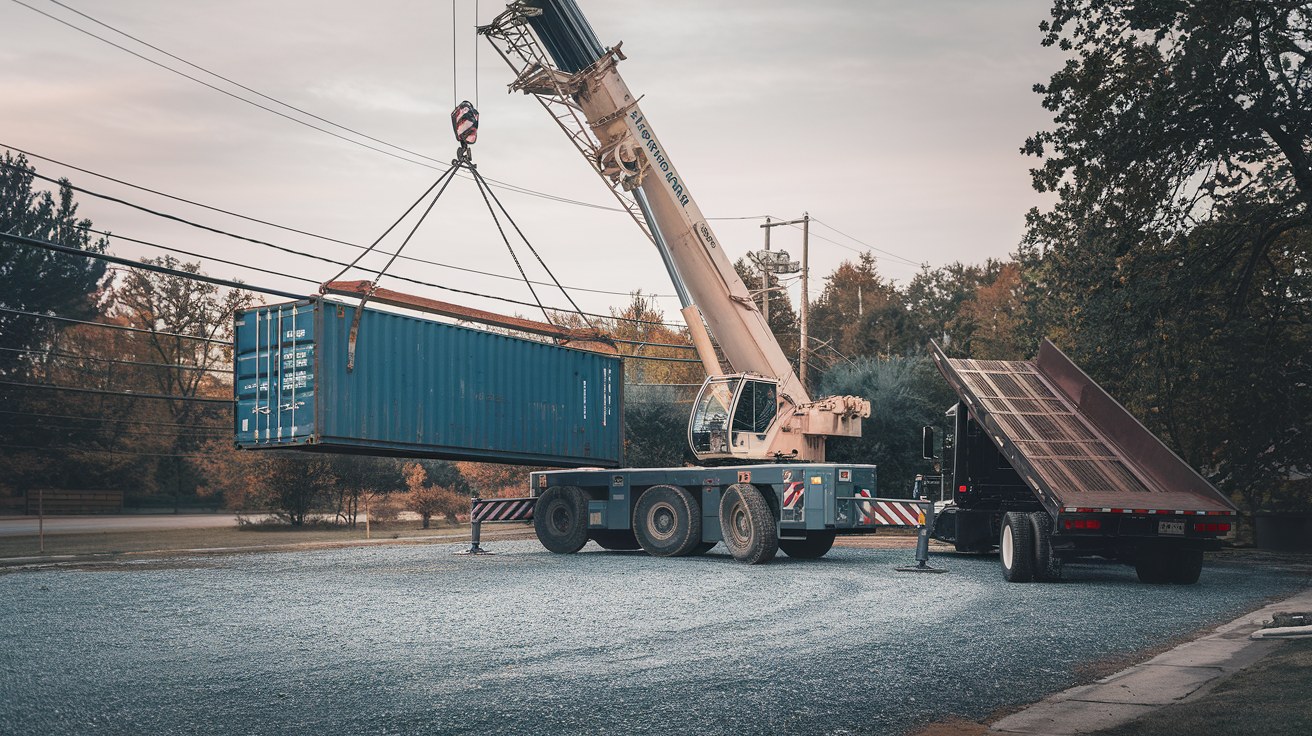
Most container deliveries in the Northeast happen on a tilt-bed truck. The driver backs into position, tilts the bed, and slides the unit onto prepared ground. It’s the cheapest method and it works for the majority of sites. But it needs roughly 100 feet of straight-line clearance, firm level ground, and no overhead obstructions — and a meaningful share of jobs don’t have all three.
When they don’t, the job goes to crane delivery. That’s a different piece of equipment with a different cost structure, and it’s exactly the equipment class the Commerce Department is proposing to tariff. Yards that replace or expand crane and lifting fleets in 2027 will be buying into a higher cost basis, and equipment costs eventually reach the delivery quote. Not next week. But the direction is one way.
The same logic runs through the trailer categories. Chassis, roll-off trailers, and the tilt-bed equipment that moves containers over the road all sit in a steel-intensive fleet that’s been absorbing rising input costs since April. Our delivery and placement guide walks through what determines whether your site is a tilt-bed job or a crane job — access route, slope, ground firmness, overhead clearance — and that determination is now a cost-forecasting question, not just a logistics one.
What the Container Market Itself Is Doing Right Now
The box side of the market is comparatively calm, and buyers should hold both facts in their head at once.
Drewry’s World Container Index put the global average for shipping a 40-foot container at $4,339 as of August 13, up about 1% on the week, driven mainly by transpacific rate strength. That’s elevated but not disorderly. On the U.S. resale side, used 20-foot units are running roughly $1,200 to $2,800 depending on grade and market, with used 40-foot units in the $1,800 to $3,500 band — wide dispersion, which is what a fragmented downstream market looks like.
Upstream is where the interesting wrinkle is. Chinese factories are booked heavily through October, July production reached 767,186 TEU, and 20-foot allocation has tightened noticeably. Depot dry stock fell by roughly 81,900 TEU in the August reporting period. This isn’t a shortage in the 2021 sense — the absolute stock is still large enough to prevent a broad price spike — but it does mean buyers who specifically need 20-foot units should secure a dated release earlier than buyers with flexible 40-foot requirements. If your project can go either way on footprint, our breakdown of container dimensions is the right place to run that decision, because the availability picture now argues for flexibility where the site allows it.
The demand side hasn’t softened. A record 2.47 million TEU landed at U.S. ports in July, and Northeast small-bay warehouse vacancy is under 5% with Northern New Jersey asking rents at $19 per square foot and climbing. That’s the arithmetic that keeps pushing businesses toward containers for on-site storage instead of another lease renewal — and it’s the same arithmetic we covered in our overview of the key trends shaping the container sales industry.
Where This Shows Up in Your Quote

Nothing on your invoice changes this month. The proposal is a proposal, comments close August 27, and any implementation follows after that. But three things are worth understanding about how equipment tariffs travel to a container buyer.
First, delivery is priced off equipment cost, not container cost. A dealer’s delivery rate reflects truck time, driver time, fuel, insurance, and the amortized cost of the equipment doing the work. Container prices and delivery prices move on separate clocks. Buyers who negotiate hard on the unit and shrug at the delivery line often leave more money on the table than they realize — a dynamic our guide to negotiating container prices covers in detail.
Second, site prep is the lever you actually control. If your ground is firm and level and your access route is clear, you get a tilt-bed job. If it isn’t, you get a crane, and the gap between those two numbers is usually larger than any price movement the tariff proposal could produce. Spending a weekend on grading and clearance is the highest-return hour in the entire purchase.
Third, the fall calendar is tighter than the news cycle suggests. Northeast ground work gets harder after October. Permit review queues lengthen. If a container is on your Q4 plan, the binding constraint is the season, not the rulemaking.
What to Do Between Now and Fall
If you’re buying in the next ninety days, the practical moves are straightforward. Get the site assessed before you get the quote, so you know whether you’re pricing a tilt-bed or a crane job. Lock delivery terms in writing at the same time as the unit price rather than treating delivery as a follow-up conversation. And if you need a 20-foot footprint specifically, move earlier than you otherwise would, because that’s where allocation is tightest.
For buyers still deciding on condition and grade, our walkthrough of what to look for when buying a shipping container covers the inspection points that separate a unit worth its price from one that needs welding by year three, and our overview of affordable options for buying shipping containers lays out where the real savings live. Buyers shopping 20-foot units or browsing the full range of new and used containers will find current inventory across our New York and New Jersey yards, along with Pennsylvania, Ohio, Rhode Island, Connecticut, and Texas.
The Bottom Line
The headline everyone will read is “new tariffs.” The detail that matters is which line of your invoice they touch. Containers aren’t in this proposal. The cranes and trailers that move them are, and that cost travels slowly — through equipment fleets, into delivery rates, over quarters rather than weeks.
So the fall timeline isn’t a panic. It’s a planning question. Get your site right, price delivery as seriously as you price the box, and don’t let anyone tell you a 50% tariff is about to land on the container itself. It isn’t.
If you’re sizing up a container for storage, a jobsite, or a build this fall, our team can walk your site conditions, quote the unit and the delivery together, and tell you honestly whether you’re looking at a tilt-bed or a crane. Request a quote today and get the delivery question settled before the ground turns.
Sources: Federal Register, “Request for Public Comments on the Proposed Implementation of Duties on Additional Aluminum, Steel, and Copper Derivative Articles Under Section 232” (August 6, 2026); Supply Chain Dive (August 6, 2026); KPMG TaxNewsFlash (August 2026); Mohawk Global trade advisory (August 2026); Drewry World Container Index (August 13, 2026); Muwon USA August 2026 North American Container Market Report; StorageCafe and Northeast industrial market reporting (2026).