
Drewry’s World Container Index fell 3 percent to $4,429 per 40-foot container on October 29, 2026, and the Shanghai to New York lane dropped 5 percent to $9,631, reversing two weeks of increases. Drewry expects further declines next week as US import demand eases, and trade coverage of its release cites the National Retail Federation forecasting ocean import volumes 11 percent lower in November than in October. For a Northeast buyer pricing a used or one-trip container for a jobsite, farm, or storage yard, fewer boxes arriving at East Coast ports changes how much room a winter quote has.
Below we cover what the freight and import numbers say, what the Port of NY/NJ data shows about empty containers, how long a lower ocean rate takes to reach a quote, where buyers can negotiate, and three steps for this week. Our running read on the trends shaping the container sales industry has followed the 2026 import cycle from the spring peak, and this is the first month the cycle clearly points down.
What Do the Latest Freight and Import Numbers Say?
Freight rates and US import volumes are both easing heading into November. Drewry’s World Container Index put the composite at $4,429 per 40-foot container on October 29, 2026, down 3 percent, with Shanghai to Los Angeles down 6 percent to $7,514 and Shanghai to New York down 5 percent to $9,631. A Hudson Valley farm-stand owner pricing a one-trip 20-foot for a February delivery, for example, is quoting against a lane that Drewry expects to slip again next week.
Volume is the other half. The National Retail Federation’s Global Port Tracker, published September 10, counted 2.31 million containers for September, up 9.6 percent from a year earlier and the busiest month of 2026, then forecast 2.11 million for October, 2.0 million for November, and 2.03 million for December. Jonathan Gold, NRF’s vice president for supply chain and customs policy, said at the time, “We thought the peak season would be mostly behind us by now, but that’s not the case.” That September forecast implied a drop of about 5 percent from October to November, so an 11 percent figure in the latest coverage is a steeper slide.
Rates are not collapsing. Drewry notes that Strait of Hormuz disruptions continue, with only two vessels passing last week, and that carrier capacity management and possible surcharges will shape rates in the coming weeks. The New York lane at $9,631 is still more than double the global composite.
What Does Port of NY/NJ Data Say About Empty Containers?
Import empties at the Port of NY/NJ rose 29 percent from January through August 2026 compared with the same months of 2025, while August export empties fell 8.5 percent. The Port Authority’s August figures, reported by Port Breaking Waves on September 25, 2026, show 789,875 TEUs in total, down 5.5 percent year over year, with export empties at 265,653 TEUs against 290,356 a year earlier. A New Jersey storage buyer shopping this month is looking at a region where empties have been arriving faster and leaving more slowly than a year ago.
Imports themselves were 404,080 TEUs in August, down 2.9 percent, and rail moves fell 9.8 percent to 55,028 containers. Fewer containers moving inland by rail while empties accumulate can leave more idle units in the port area, although the Port Authority data does not say how many of those empties are for sale. August is the latest full month in the sources we checked.
Our experience on the sales desk fits that direction. When fourth-quarter volume softens, Northeast depots carry more idle 20-foot cargo-worthy units into January, and sellers tend to move on delivery terms and bundled quantities before they move on the unit price. That is a pattern across several winters at Giant Lockbox and not a count of this year’s orders. Our guide to where to buy used shipping containers explains how to tell depot stock from inbound stock before you commit.
How Quickly Does a Lower Ocean Rate Reach a Northeast Quote?
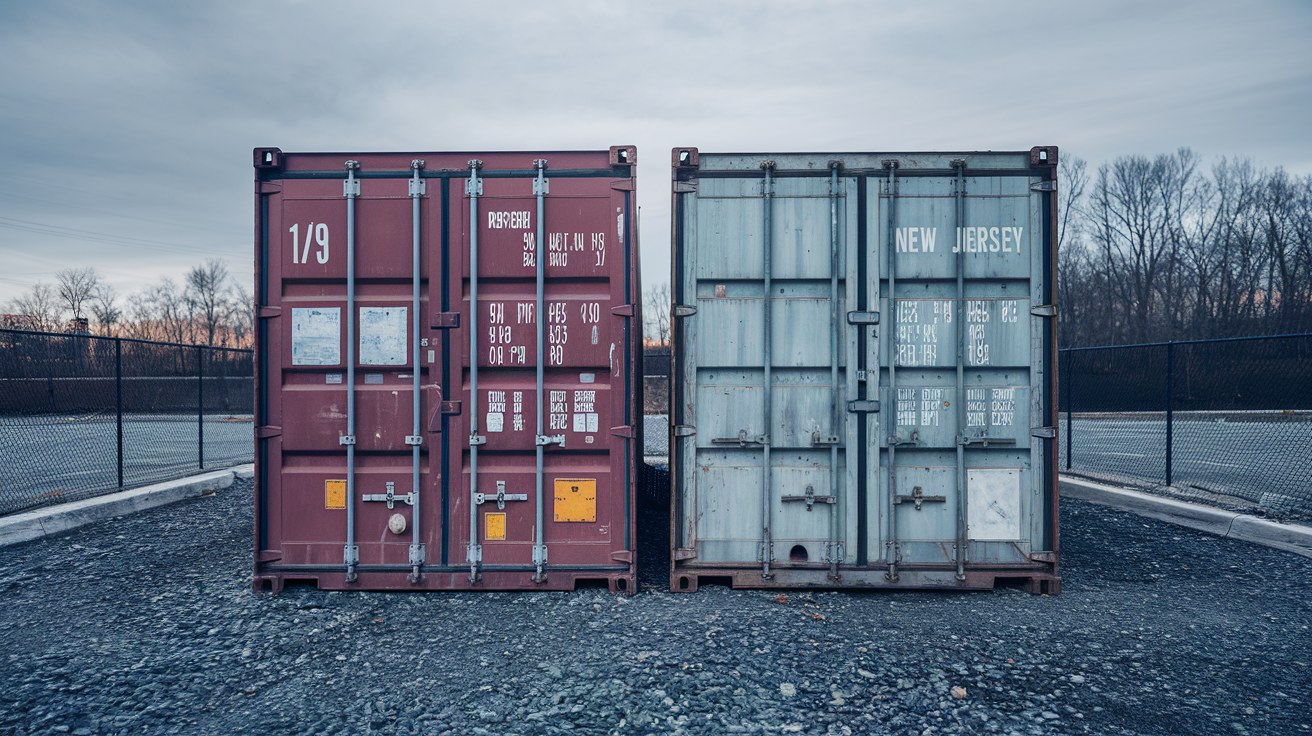
A lower ocean rate reaches a Northeast one-trip quote about six to ten weeks later, and as a few hundred dollars rather than the full change in the lane. Container Sales Group’s 2026 pricing guide puts one-trip 20-foot units at roughly $2,500 to $4,500 delivered and one-trip 40-foot high cubes at $3,500 to $5,500 as of mid-2026, a spread wide enough that a few hundred dollars of freight sits inside it. A buyer who orders a one-trip 40-foot high cube in early November is likely paying for a box bought and shipped under October’s rates, so a quote written this week probably still carries the old lane.
Used units follow a different clock. Eveon’s market monitor, checked on October 30, 2026, put the US average used price at $1,759 for a 20-foot and $2,260 for a 40-foot high cube, and Container Management’s 2026 cost guide puts delivery within 100 miles of a depot at $350 to $850 as of September 2026. A used cargo-worthy unit already standing in a Pennsylvania depot is priced against local demand and haul distance, so a Shanghai lane rate does not touch it.
One date sits in the same window. USTR proposed on October 23 to keep its Section 301 ship fee suspended through January 9, 2027, according to gCaptain. A one-trip unit that sails after that date could meet the fee if the pause lapses, so ask any seller quoting a box that has not yet shipped how its price changes in that case. Our advice on negotiating container prices applies here, since a written price cap costs a seller less than a price cut.
Where a Northeast Buyer Can Negotiate This Winter
Negotiating room this winter sits mostly in delivery terms, timing, and the choice between used and one-trip stock. A buyer who asks a seller to hold a price through a stated delivery date, or to include the haul within a stated radius, is asking for something a seller with idle units can give more easily than a lower unit price.
Timing matters because the cushion is seasonal. In our experience, Northeast used and one-trip stock tightens each March when ADU and construction season starts, and $200 to $400 jumps on a 20-foot cargo-worthy unit are common in those weeks. A buyer who locks a unit in January or February avoids that window, provided the pad is ready. We make no call on where prices will be in March, because Drewry’s own commentary points to surcharges and capacity cuts that could move rates either way.
Size and grade shape the decision too. A used cargo-worthy 20-foot covers tool storage and retail overflow for most buyers, while a one-trip 40-foot high cube suits a jobsite office or a modification build. The shipping container dimensions guide helps settle that before a quote, and our overview of the types of shipping containers for sale covers the grades.
Three Steps to Take This Week

First, ask where the unit is today. A seller should be able to say whether the box is in a Northeast depot, on the water, or not yet shipped, and give a delivery date for each case. A unit in a depot has a date you can plan around.
Second, walk the site before the ground freezes. Check for a firm, level pad, overhead clearance on the approach, and gate width. Our delivery and placement guide lists what a site needs before a date is set.
Third, inspect the unit or have it inspected. The inspection checklist shows how to separate cosmetic rust from structural damage, which matters more on a discounted used unit than on a one-trip box.
The Bottom Line
Buyers who need a container by spring have a few quiet weeks in which sellers with idle Northeast units are likelier to flex on delivery terms than they will be in March. One-trip quotes written this week likely still carry October’s ocean freight, so ask for the sailing date before comparing one with a used unit that is already in a depot.
Your step this week costs nothing. Pull any quote you hold, find the line that says where the unit is today and what the delivered price includes, and email the seller asking for both in writing.
We can tell you which units are standing in a Northeast depot today and what the delivered number is for your address. For used containers across New York and New Jersey, request a quote today.
A note on how this article was written: we use AI to help draft and research pieces like this, then a Giant Lockbox team member edits for accuracy and voice. Here’s how and why we use AI in our content.
Sources: Drewry World Container Index, October 29, 2026, as published by The DCN and Interior Daily on October 30, 2026; National Retail Federation Global Port Tracker, September 10, 2026, as reported by Talk Business & Politics; Port Authority of New York and New Jersey August 2026 volumes, as reported by Port Breaking Waves, September 25, 2026; gCaptain, USTR Proposes Extending China Ship Port Fee Suspension Through January 2027, October 23, 2026; Eveon Containers, Market Monitor, accessed October 30, 2026; Container Sales Group, 2026 pricing guide; Container Management, 2026 cost guide.