
The most consequential line on a container quote isn’t the size or the headline price — it’s the grade. Two 20-foot boxes can sit ten feet apart in the same yard, look nearly identical from the road, and carry a thousand-dollar spread between them because one is certified cargo-worthy and the other is graded wind-and-watertight by eye. The word “used” hides four different products at four different prices, and the buyers who lose money almost never lose it on size. They lose it on grade.
That matters more in 2026 than it has in years. The resale fleet is aging, the price gap between new and used has reopened, and insurers are quietly tightening what grade they’ll underwrite for anyone building a structure out of steel — dynamics downstream of the broader key trends shaping the shipping container sales industry. Here’s the spectrum, what each tier costs, and how to match grade to job.
What the Grades Actually Mean
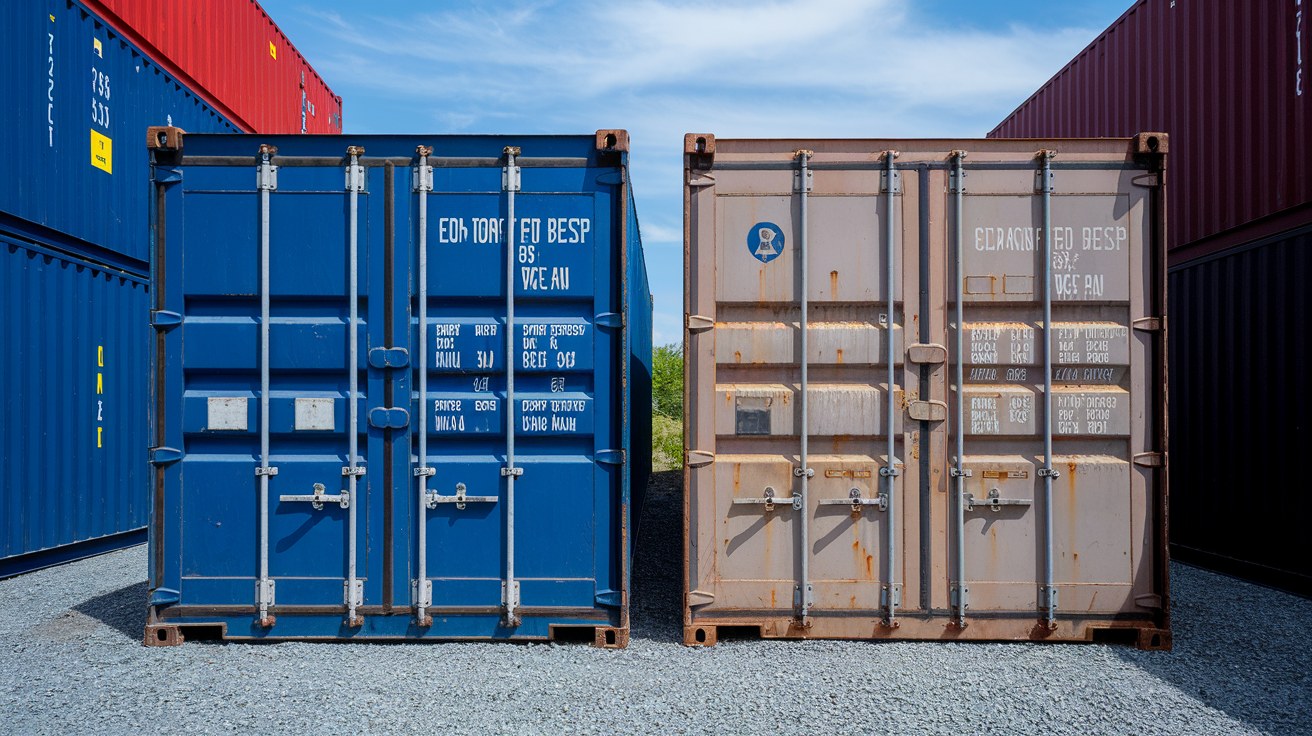
A one-trip container has crossed the ocean exactly once with cargo, never entered depot rotation, never done any other job. Original paint, no meaningful rust, minimal dents, pristine floors and seals. In 2026 a one-trip 40-foot high cube runs roughly $4,000 to $6,000, and a one-trip 20-foot lands around $2,500 to $3,100, per Container Sales Group’s 2026 grade guide and Metal-Buildings.org’s cost data. You’re paying for near-new condition and a predictable starting point for a build.
Below that sits cargo-worthy, the grade most buyers should understand best because it carries an actual certification. A marine surveyor has inspected the unit and confirmed it’s structurally sound enough to re-enter international shipping — solid floors, working doors, intact seals, with minor dents and localized surface rust treated as normal. Cargo-worthy 40-foot units generally run $2,500 to $3,500, per Container Sales AZ and Foursons Logistics. The certification is the point: a documented standard, not one operator’s opinion.
Then comes wind-and-watertight, the grade that trips up the most buyers. WWT means a depot operator graded it by eye alone — doors seal, no daylight through the walls, keeps water out. These run roughly $1,500 to $2,500, per Container Sales AZ. The catch, spelled out by Foursons and CHS Container Group, is that WWT does not mean cargo-worthy and does not guarantee the unit could be certified for shipping. For a box that sits on a pad and holds tools, that’s often fine. For anything else, the distinction is the whole ballgame. Below WWT sits as-is, sold with known damage at the lowest price — fine for scrap-tolerant projects, a trap for everyone else. Our checklist on what to look for when buying a shipping container shows how these tiers read in the metal.
Why the Grade Gap Widened in 2026
For a stretch of 2024 and 2025, a soft market compressed the spread between grades — used pricing firmed up close enough to one-trip that the premium for near-new felt small. That compression has unwound. With the market finding equilibrium this year, the gap between new and Grade A used has reopened to a genuine 35 to 40 percent, per ContainerEU’s 2026 analysis. A grade decision that barely moved the number two years ago now moves it by four figures.
The bigger shift is the age of the fleet. Containers historically entered the resale market at 7 to 15 years old; today many aren’t released until 10 to 20 years, per Arcon Container’s 2026 outlook. The average wind-and-watertight or as-is unit is now older and more variable than the same grade would have been a few years back. The label still tells you the tier — it tells you less than it used to about the specific box wearing it, which is why inspection and dealer trust have moved to the center of the decision.
A cargo-worthy unit at $3,000 can beat a wind-and-watertight unit at $2,200 if the WWT box is a rusting fifteen-year-old and the certified one has years left in it. Our guides to affordable options for buying shipping containers and where to buy used shipping containers make the same point: in an aging-fleet market, the cheapest grade and the best value are rarely the same unit.
The Insurance Angle Nobody Mentions Until It’s Too Late

Here’s the detail that catches container-home and modular-build buyers off guard. Most commercial property insurers in 2026 heavily favor — and a growing number strictly require — one-trip units when they underwrite a structure built from a shipping container, per Container Sales Group’s 2026 reporting. The logic is simple from the underwriter’s chair: a one-trip box has a known condition and a predictable service life, while a fifteen-year-old wind-and-watertight unit is an inspection question mark they’d rather not insure as somebody’s dwelling.
The trap is buying on price first and discovering the requirement after the fact. A buyer sizing an ADU or container home who saves $1,500 on a wind-and-watertight unit can lose that saving and more if the insurer won’t write the policy — or writes it at a penalty — because the structure isn’t one-trip. For anyone converting steel into occupied or heated space, the grade decision belongs at the front of the project, not after the pad is poured. Our overview of container security features treats grade as a build input — because that’s how the permitting and insurance side treats it too.
Matching the Grade to the Job
Strip away the jargon and the decision comes down to what the box has to do.
For basic stationary storage, wind-and-watertight is usually the right grade and the right price. If the container will hold equipment, inventory overflow, or seasonal gear on a fixed pad, you’re paying for dry and secure — not for certification you’ll never use. This is where the value lives, and where our look at using shipping containers for storage shows the everyday jobs a WWT unit handles without complaint. Just inspect it, because in an aging fleet the label covers a wide condition range.
When the container has to move or bear load, step up to cargo-worthy. Repeated transport, stacking, crane lifts, or any use where the steel does structural work is where that surveyor certification earns its premium. The documented standard protects you when the box has a harder life than sitting still.
When appearance, modification, or insurability matters, buy one-trip. Retail conversions, offices, food service, homes — anything a customer or inspector will see or occupy — start from near-new steel because clean panels take modification better and clear the insurance bar. If you’re weighing footprint alongside grade, our shipping container dimensions guide helps you settle size and configuration in the same pass. And our primer on negotiating shipping container prices is worth a read first — grade is the one spec where paying up is often the cheaper decision over the life of the box.
How to Verify the Grade You’re Paying For
A grade is only as good as the proof behind it, and the standard of proof differs sharply by tier. Cargo-worthy is the one grade backed by a document — a marine surveyor’s certification — so if a seller quotes it, ask to see it. Wind-and-watertight rests on a depot operator’s visual call, which means the seller’s credibility does most of the work. That’s not a reason to avoid WWT. It’s a reason to buy it from someone who lets you see the actual unit.
The verification steps are the same ones that protect you against fraud: confirm the container ID and CSC plate, get current photos of the specific box rather than stock images, and walk the yard if you can. A reputable dealer produces a clear photo of the ID and plate in minutes because the container is really sitting there. The discipline that stops a scam confirms a grade — you’re checking that the box exists, that it’s the one in the listing, and that its condition matches the quote.
A high-volume gateway keeps depots stocked across grades, which is why availability stays solid in both used and one-trip condition across our New York and New Jersey markets — and why you can compare grades side by side rather than taking whatever a distant seller happens to have.
The Bottom Line
Grade is the spec that quietly decides your total cost — not the sticker price, but the modification, the insurance, and the years the box lasts. One-trip buys near-new steel and clears the insurance bar for structures. Cargo-worthy buys a certified standard for anything that moves or bears load. Wind-and-watertight buys dry, secure storage at the best price, as long as you inspect it. In a 2026 market where the fleet is older and the price gaps are wider, matching grade to job is the difference between a smart buy and an expensive lesson.
If you’re weighing a purchase and aren’t sure which grade the job calls for, our team can walk you through current new and used inventory across every grade, show you the specific unit before you pay, and point you to the right box — including the accessible 20-foot inventory where used pricing stays most competitive. Request a quote today — tell us the job, and we’ll tell you the grade it actually needs.
Sources: Container Sales Group 2026 shipping container grades guide; Container Sales AZ container grades explained; Foursons Logistics shipping container grades guide; CHS Container Group grades overview; Metal-Buildings.org 2026 container cost guide; ContainerEU 2026 container market analysis; Arcon Container 2026 market outlook.