
A foot of wet snow weighs up to 21 pounds per square foot, which puts as much as 3,340 pounds on the roof of a 20-foot shipping container. Northeast buyers saw what that arithmetic means in February 2026, when FOX Weather reported nearly 28 inches of snow in Newark, a record 31 inches in Islip, and about 38 inches in Providence from a single blizzard.
Below we cover what snow weighs on a container roof, what a standard roof is tested to carry, where older and modified units run into trouble, and how to clear a roof without climbing on it. The ground under the unit comes first, and our shipping container delivery and placement guide covers the pad. Our reference on shipping container dimensions supplies the sizes behind the roof areas used here.
What Does Northeast Snow Weigh on a Container Roof?
Snow adds between 3 and 21 pounds per square foot of roof for each foot of depth, which comes to roughly 480 to 3,340 pounds on the 159-square-foot roof of a 20-foot container. FEMA publishes that range, 3 pounds for light, dry snow and up to 21 for wet, heavy snow, as cited in FOX Weather’s roof-load explainer. Newark’s nearly 28 inches in the February 2026 blizzard is about 2.3 feet of depth, so the same arithmetic gives roughly 1,100 pounds at the dry end and 7,800 pounds at the wet end, before settling, melting, or wind drift changes how much stayed on top.
Building codes work from a design number. The Massachusetts amendments to the 2021 International Building Code (780 CMR) list a ground snow load of 40 pounds per square foot for Boston and 50 for Worcester, with minimum flat-roof design loads of 30 and 35. On a 20-foot roof that is about 4,800 pounds in Boston and 5,600 in Worcester, and on a 40-foot roof of about 316 square feet it is roughly 9,500 and 11,100. A loose container on a pad is not designed to those values, yet they show what an engineer assumes when you ask for sign-off on an occupied conversion. Your own town’s table will carry different numbers.
A warm forecast does not remove the question. OpenSnow’s October 15 write-up of the NOAA winter outlook expects a very strong El Niño and a warm eastern half of the country this winter, and the February 2026 totals above arrived in one weekend.
How Much Load Is a Container Roof Built to Carry?
A standard shipping container roof is tested to carry a 300 kilogram (660 pound) concentrated load over a 600 by 300 millimeter patch, and the whole box is tested for stacking through its four corner fittings. Both tests are written into Annex II of the Convention for Safe Containers (CSC), as reproduced in South Africa’s Merchant Shipping (Safe Containers Convention) Act of 2011. Spread across a patch of about 2 square feet, 660 pounds works out to roughly 330 pounds per square foot, many times the 30 to 35 pounds per square foot that the Massachusetts table sets as the minimum flat-roof snow load for Boston and Worcester.
That comparison does not certify a container roof for snow. The CSC roof test applies one load at the weakest spot of the roof and carries no snow rating, and we have not found a published snow rating for a standard ISO unit. The standard does show a tested path for vertical load. The TIS-GDV container handbook, published by the German insurance industry, notes that stacked containers pass their forces into the corner posts, and the allowable stacking weight is marked on each unit’s Safety Approval Plate. A snow blanket spread across the roof reaches those same posts through the top rails.
Older Roofs, Cut Openings, and Rooftop Additions
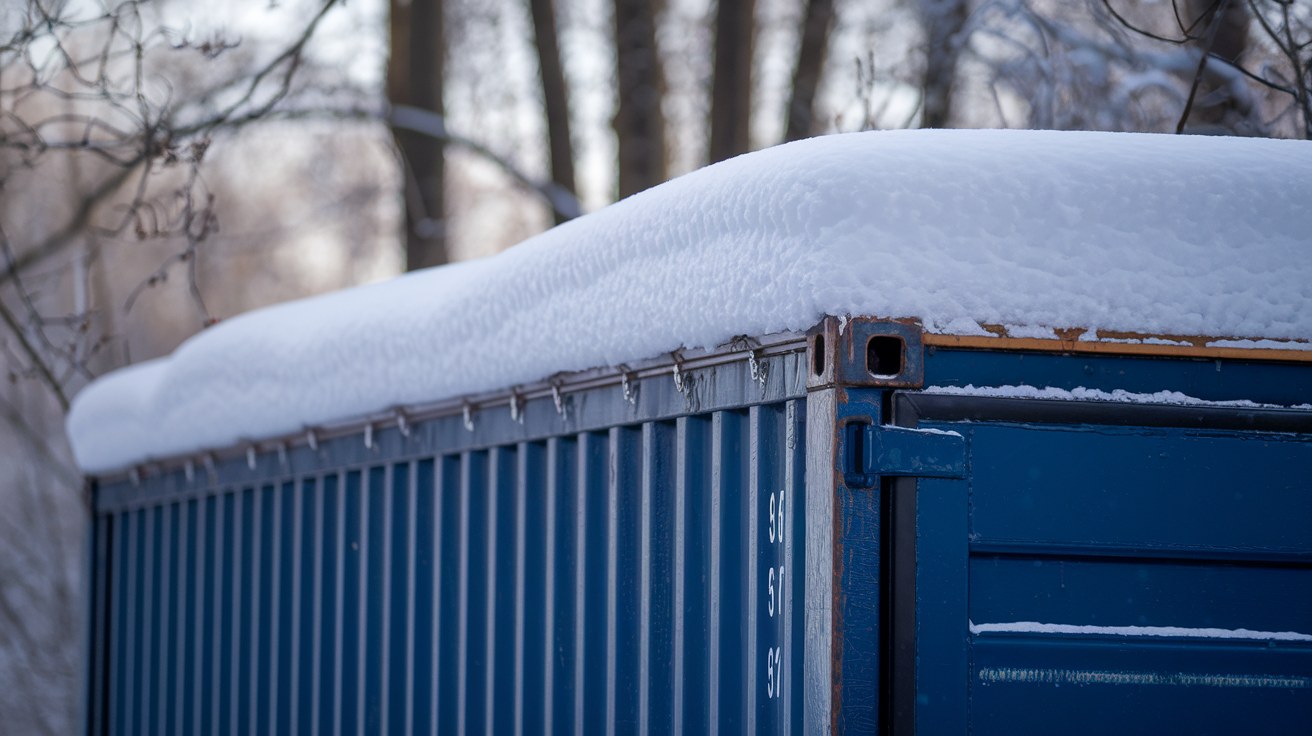
The margin shrinks where a unit has been worn or changed. A used container with a dented roof panel can hold a pool of meltwater that freezes and then holds more snow on top of it. Evéon Containers’ winter guide recommends checking the roof and sides for holes, for areas that hold water, and for dents that trap water, and sealing pinholes with silicone or caulk. Our checklist on what to look for when buying a shipping container covers roof and seam checks to run before you pay, and our overview of the different types of shipping containers for sale explains how grade affects what you are buying.
Modifications change the frame. A window or roll-up door cut into a side wall removes corrugated steel that stiffens the wall, and a rooftop air conditioner or solar array adds dead load to the roof. When people will occupy the container, Chapter 16 of the International Building Code applies, including the local ground snow load, and a licensed engineer or architect has to size any reinforcement. Our guides to modification options, the customization process, and container homes and other alternative living spaces show where those decisions land. Ask any fabricator which snow load their design assumed for your address and get the answer in writing.
How Do You Clear a Container Roof Safely?
Clear a container roof from the ground with a long-handled snow rake, and do not climb up without fall protection. OSHA’s general industry rule at 29 CFR 1910.28 requires protection from unprotected edges at 4 feet, and a standard container stands 8 feet 6 inches tall. A high-cube unit at 9 feet 6 inches puts anyone on the roof at more than twice that height, on steel that is slick with frost.
A few inches of snow adds only a few pounds per square foot on FEMA’s range, so it can stay where it is. Deep, wet snow that has sat for days, and any roof that shows sag or standing meltwater, is the case worth acting on.
We have sold and modified containers in the Northeast since 2013, and the winter calls we take are more often about frozen door gaskets, ice sheets sliding off the roof edge, and units frozen to the ground than about a roof giving way under snow. That is a pattern from our calls and not a count of failures.
Evéon Containers’ winter guide recommends oiling door hinges, checking door seals, and setting 4-by-4 wood blocks under the corner posts when you plan to move a unit in winter, because a unit set directly on the ground can freeze in place. Our guide to the security features of shipping containers covers lock and door hardware that also needs a winter check. Keep the door-side approach clear of hanging ice.
The Bottom Line
A standard container roof is tested for a concentrated load far above a Northeast flat-roof design snow load, and nothing in that test rates it for snow. The units to watch are dented used roofs, walls with cut openings, and anything carrying equipment on top.
Your step this week costs nothing. Look up your town’s ground snow load in the local building code table, multiply the flat-roof value by 159 for a 20-foot unit or 316 for a 40-foot unit, and compare the result with the condition of the roof you have or plan to buy. Our look at using shipping containers for storage covers the setups that suit most Northeast sites.
We can match a unit to your site and tell you what the roof and walls look like before it ships, with used containers and 20-foot units delivered across New York, New Jersey, Pennsylvania, and Rhode Island. Request a quote today.
A note on how this article was written: we use AI to help draft and research pieces like this, then a Giant Lockbox team member edits for accuracy and voice. Here’s how and why we use AI in our content.
Sources: FEMA snow-weight figures (FEMA 957) as cited by FOX Weather; FOX Weather reporting on the February 22 to 23, 2026 Northeast blizzard; Massachusetts amendments to the 2021 International Building Code, 780 CMR Chapter 16, Table 1604.11; Convention for Safe Containers Annex II as reproduced in South Africa’s Merchant Shipping (Safe Containers Convention) Act of 2011; TIS-GDV container handbook, structural loads; Evéon Containers winter preparation guide; OpenSnow, NOAA 2026 to 2027 winter forecast, October 15, 2026; OSHA 29 CFR 1910.28.