
If you set a container down on a job site or a back lot in early June, the clock on it has probably already run out. Most municipalities that allow temporary storage containers without a full permit cap the stay somewhere between 30 and 90 days, and a June delivery lands squarely at the far end of that window right about now. Code enforcement doesn’t work in real time. It works on complaints and on the late-season inspection cycle — which is exactly what August starts.
This catches a specific kind of buyer: the one who did everything right on the purchase and nothing at all on the paperwork. Plenty of people compare grades, walk a yard, and negotiate hard on a used shipping container, then take delivery without ever calling the zoning office. The container is usually fine. The placement is the problem. What follows is what the rules actually turn on, how the clock works in practice, what getting it wrong costs, and the four things worth settling before the truck rolls.
What Permit Requirements Actually Turn On
Container permitting sounds arbitrary until you see the logic underneath it, and then it’s fairly consistent from town to town. Per ContainerOne’s 2026 U.S. zoning guide, whether you need a permit comes down to three variables: the zoning classification of your parcel, the intended use of the container, and whether it’s going on a permanent foundation. Everything else — setback tables, screening rules, height limits — is downstream of those three answers.
Zoning classification does most of the work. Commercial and industrial parcels generally allow containers as accessory storage structures with far fewer restrictions than residential land. Residential zones are where the friction lives. Many allow temporary storage with a time limit and nothing else, some require an administrative permit, and a handful — San Antonio’s code is a clean example — don’t allow containers in residential zones at all except by temporary use permit tied to an active construction project on the same parcel, capped at 30 days.
Intended use is the second lever, and buyers underestimate it. Storage is treated one way. A container converted into an office, a shop, or living space is treated as a building, which pulls in occupancy, egress, and structural review. If you’re planning modifications — doors, windows, HVAC, electrical — you’ve usually crossed from “storage” into “structure” in the eyes of the code official, and that reclassification happens whether or not anyone tells you.
The third variable is the simplest and the most decisive. In 2026, most municipalities treat a container as a permanent structure the moment it sits on a foundation or gets connected to utilities. A unit resting on timber blocks or a gravel pad usually stays in the temporary category. Pour footings or run a service line and you’ve built something.
The 30-to-90-Day Clock That Catches Summer Projects
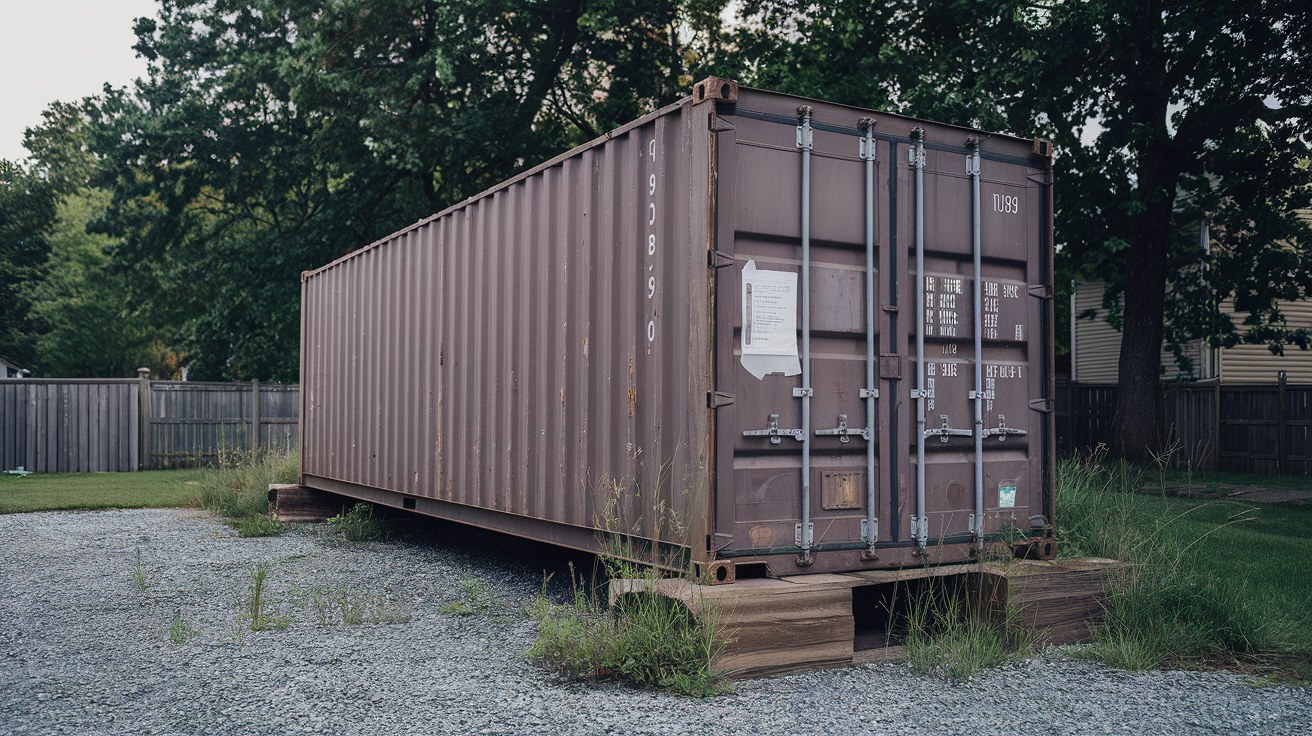
The temporary-use exemption is the most common way a container ends up on a property, and almost nobody reads the fine print. Common caps run 30 to 90 days. Some are much tighter — ordinances in the 7-to-60-day range exist, and several count days within a rolling six-month period rather than a single continuous stay, which quietly kills the “move it off for a weekend and reset the counter” strategy.
Here’s the practical problem with summer projects. A container delivered for a June renovation, a barn cleanout, or a seasonal inventory overflow is doing useful work through July. By August the project is finished or stalled, the unit is still full, and moving it is a hassle nobody has scheduled. Leaving a temporary container on-site after the project ends is the most common violation in the category — not because owners are defiant, but because the removal was never planned.
Two things make late summer the pinch point. Neighbors are outside and looking at your yard. And code departments tend to clear complaint backlogs and run site inspections ahead of the fall permitting rush.
There’s a second clock most buyers never see: HOA and deed restrictions. Plenty of homeowners associations prohibit visible storage containers outright regardless of what the municipality allows, and deed restrictions attached to a title can do the same. Zoning approval is not HOA approval. Separate approvals, separate enforcement — and the HOA is usually faster.
What Getting It Wrong Actually Costs
The fines by themselves are survivable. The removal is what stings.
Penalty structures vary widely and they’re worth knowing in advance. Some ordinances assess a flat $25 per day for each day a violation continues. Others set a floor of $100 and a ceiling around $2,000. First-violation schedules in the $50 to $150 range are common in smaller jurisdictions, and at the aggressive end some cities run daily penalties up to $1,000. The pattern that matters isn’t the number — it’s that most of these accrue daily, so a violation you ignore for six weeks isn’t the same violation you’d have paid off in three days.
The real cost is mandatory removal. According to OnSite Storage’s 2026 permit guidance, forced removal expenses can run to roughly double the original delivery cost — an unscheduled truck, a tight-window pickup, often a second placement somewhere else, plus the labor to empty a full container on a deadline you didn’t set. On a unit that cost $1,300 to $2,000 used in the 20-foot size, or $2,000 to $3,200 for a 40-footer at 2026 market pricing, an enforcement-driven relocation eats a meaningful share of what you paid.
Compare that against doing it right. Temporary use permits typically run $25 to $150. A simple accessory structure permit comes in under $100 in many jurisdictions, up to a few hundred elsewhere. Full building permits for a foundation-mounted or occupied container are a different tier — commonly $500 to $3,000 or more depending on local fee schedules and whether structural review is required. In almost every scenario the permit is cheaper than the fine plus the removal, and it isn’t close.
When “Temporary” Becomes “Permanent”
Permanent placement is a different conversation, not a harder version of the same one. Once a container is going on footings, staying indefinitely, or being occupied, you’re in accessory structure territory: a site plan showing placement and setbacks, confirmation of zoning compliance, and sometimes a structural or engineering review for modified units.
Setbacks are where plans get redrawn. Requirements run from about 5 feet in some rural areas to 25 feet or more in suburban zones, and they’re measured to the property line, not the fence. This is the single most common reason a container ends up somewhere other than where the owner pictured it, which is why container dimensions and setback math should be checked together rather than in sequence. A 40-foot unit that fits the pad may not fit the pad plus the setback.
For residential builds, the ground has been moving. New York passed 2024 legislation permitting ADUs statewide with local input, and Senate Bill S4547A — which would direct localities to adopt ADU rules, allow one unit per residentially zoned lot, and require leases of at least 30 days — remains under review as of this writing. New Jersey passed 2024 legislation easing ADU permission across municipalities, and Pennsylvania permits container homes under a permissive state framework with local implementation. None of that means container construction is automatically approved anywhere. It means the state-level door is open and the decision has moved to your building department. If a container home or ADU is where you’re headed, our overview of alternative living spaces using shipping containers and the walkthrough of how the customization process works cover what the review will ask you for.
What to Settle Before the Truck Rolls

First, call the zoning office before you call a dealer. One question — “what applies to a shipping container on this parcel” — with your address and parcel number in hand. Ask about classification, time limits, and setbacks together. The call is free and takes ten minutes.
Second, be honest about the use. If there’s any chance the unit becomes an office, a shop, or a workspace later, ask now. Reclassifying a container after placement costs more than permitting the eventual use up front.
Third, plan the setback before the placement. Measure to the property line, not the driveway edge. Then coordinate the approach and the pad with your dealer — our delivery and placement guide covers ground firmness, tilt-bed access, and overhead clearance, and any of those can force a placement change that breaks a setback you already cleared.
Fourth, put an end date on temporary units. If you’re using the temporary exemption, calendar the removal the same day you schedule the delivery. Late-summer delivery windows tighten anyway — August through October is ocean freight peak season on the major lanes, which pulls trucking and yard capacity along with it, so a same-week pickup in September is not a safe assumption.
Buyers in our New York, New Jersey, and Pennsylvania markets face the widest spread of local rules we see, sometimes township to township inside one county. We can tell you what we’ve encountered in an area. The building department’s answer is the only one that counts.
The Bottom Line
The container is the easy part. Buyers spend weeks on grade, condition, and price — all of which our guide to what to look for when buying a shipping container covers in detail — then spend zero minutes on the question that determines whether the unit can stay where they want it. Storage capacity you can’t legally keep on-site isn’t capacity. It’s a problem with a delivery fee attached.
Nothing here requires a lawyer or a consultant. It requires one phone call, made before the purchase instead of after the notice. The buyers who make that call spend $25 to $150 and never think about it again. The ones who skip it find out in September.
For new and used shipping containers with delivery planned around your actual site — including the access, pad, and placement questions your zoning office is going to ask about — request a quote today. We’d rather work the placement out on the phone than move the unit twice.
Sources: ContainerOne 2026 U.S. Zoning Guide; OnSite Storage shipping container permit requirements; City of San Antonio IB 540 Storage Units; Fairfax County portable storage container administrative permit guidance; New York Senate Bill S4547A; Angi 2026 shipping container cost data; Suaid Global ocean freight peak season guidance.