
American agriculture is heading into fall with more crop than places to put it. USDA’s June 1 Grain Stocks report showed on-farm corn stocks up 16% from a year earlier, with total corn inventory across all positions at 5.29 billion bushels — up 14% overall — while national grain storage capacity sits stuck near 25.5 billion bushels and hasn’t meaningfully grown since 2020, per farmdoc daily’s February analysis. Now a harvest projected at a record 16.8 billion bushels of corn and 4.3 billion bushels of soybeans is weeks away. AgWeb’s August coverage put it plainly: temporary storage could be fall 2026’s pressure valve, and it can still be delivered in weeks, not months.
That pressure valve is where shipping containers enter the picture — not for the grain itself, but for everything the grain is about to displace. Farms across the country are clearing machine sheds, shop bays, and barn floors to make room for the crush, and a growing number are solving the overflow with the same steel boxes we covered in our guide to using shipping containers for storage. Here’s what the numbers say about the crunch, what a container actually solves on a working farm, and why the buying window is better in August than it will be in October.
What the Numbers Are Saying
The storage math has been tightening for a full year. On-farm capacity utilization hit a record 80% in December 2025, according to American Ag Network’s reporting on the fall crush — and that was before this year’s record plantings matured. Total national capacity breaks down to roughly 13.6 billion bushels on farm and 11.9 billion off farm, per AgWeb, and construction of new permanent storage has largely plateaued since 2020. Soft commodity prices are making the squeeze worse, not better: when grain is cheap, farms hold it longer waiting for a price, which means last year’s crop is still occupying bin space this year’s crop needs.
The commercial side offers no relief. Warehousing utilization climbed to 69.4 this summer — its highest reading since September 2022, per Inbound Logistics — as retailers front-loaded holiday inventory to get ahead of tariffs. Off-farm elevators and commercial warehouses are absorbing everyone’s overflow at once. AgWeb reports commercial handlers are already asking where grain will go when harvest starts.
None of this is a surprise to anyone who has watched the market this year. It’s the agricultural chapter of the same story we’ve tracked in the key trends shaping the shipping container sales industry — storage demand rising across every sector while the infrastructure to hold it stands still. The difference on a farm is that the deadline isn’t a fiscal quarter. It’s a frost date.
The Bin Problem Isn’t Just a Bin Problem
Let’s be honest about what a shipping container is not: it is not a grain bin. Bulk corn and soybeans need aeration, moisture management, and load-rated structures built for the purpose — and with warm weather favoring insects and high inventory concentrating risk, AgWeb’s storage specialists are blunt that monitoring and pest control aren’t optional this year. If your problem is 50,000 bushels with no home, you need temporary grain systems, not a container.
But walk any farmyard in September and the bin is only half the congestion. Bagged seed and feed, totes of chemical, fertilizer, filters and belts and spare parts, tools that migrate out of the shop and never migrate back — all of it competes for covered space exactly when the machine shed needs to swallow a combine, a grain cart, and a header or two. The overflow doesn’t need aeration. It needs to be dry, secure, and out of the way. That is precisely the job a container was built for.
First, containers free the buildings you already own. A 40-foot container holds roughly 2,350 cubic feet of dry, wind-and-watertight storage — enough to empty a shop bay of everything that isn’t a machine. Our shipping container dimensions guide lays out the real interior numbers by size.
Second, they secure what walks off. Rural equipment and chemical theft climbs every harvest, when yards sit unattended for eighteen-hour stretches. A locked steel box with the right security hardware is a different proposition than a barn door with a hasp.
Third, they arrive in days, not construction seasons. The window for permanent storage projects closed months ago. A container is delivered on a tilt-bed truck and working the same afternoon.
What a Container Actually Solves on a Working Farm
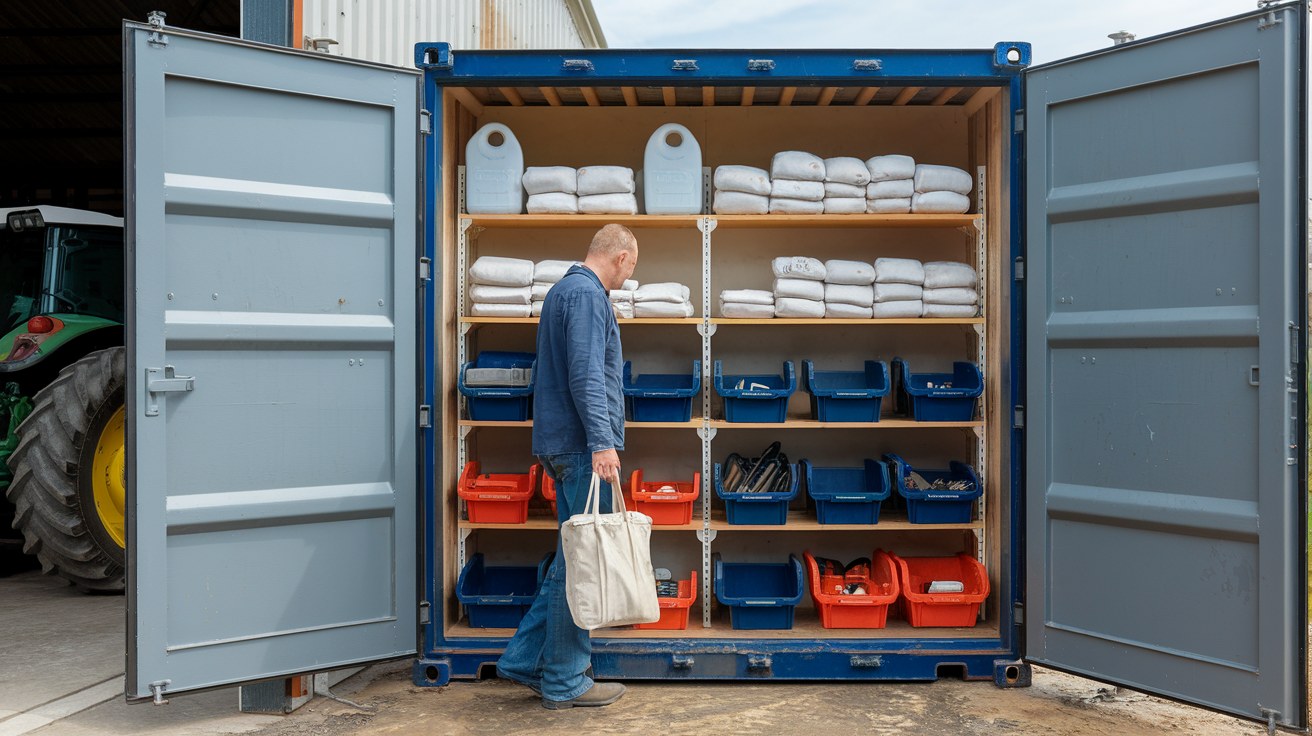
The use cases we see most from agricultural buyers cluster around the harvest calendar. Seed and input storage leads the list — bagged seed, crop protection products, and twine stay dry and locked, with ventilation and shelving added where the operation needs it. Equipment and parts storage follows close behind: harvest is when a $400 sensor failure can idle a $600,000 machine, and operations that stage parts inventory in an on-site container cut their downtime runs to the dealer. Workshop overflow, tire storage, and oil and lubricant storage round out the list.
Condition matters less here than buyers sometimes assume. For general dry storage, a wind-and-watertight used container does the job at roughly half the cost of new — current used pricing runs about $1,200 to $2,800 for a 20-foot and $1,800 to $3,500 for a 40-foot, per Metal-Buildings.org’s 2026 cost guide. The used fleet is older than it used to be, though, so inspection is worth the hour: our checklist on what to look for when buying a shipping container covers floors, door gaskets, and roof seams — the three places a bargain box hides its problems.
Placement is the step farms get wrong most often. A loaded 40-footer wants firm, level ground and a clear straight-line approach for the delivery truck, and a barnyard in November is neither. Our delivery and placement guide walks through ground prep, clearance, and why railroad-tie foundations earn their keep in freeze-thaw country. Set the container in August on dry ground and it’s a five-minute delivery. Wait for the mud and it’s a winch job.
Cold Chain, Dairy, and the Northeast Picture
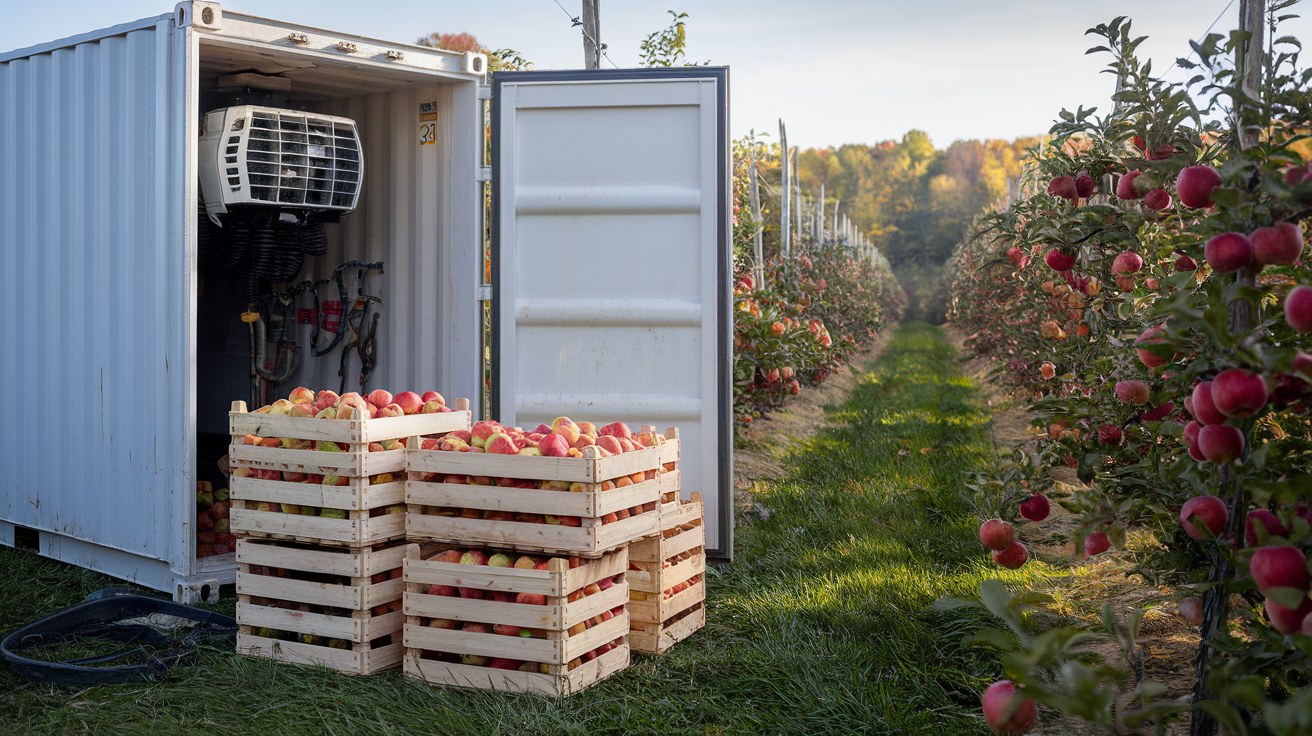
Not every farm’s crunch is grain. Northeast operations — orchards, produce growers, dairies across New York and Pennsylvania — hit their own storage wall in the fall, and theirs is temperature-sensitive. Apple harvest, fall vegetables, and animal feed all need conditioned space at exactly the moment it’s scarcest.
This is where the specialty end of the inventory earns attention. Insulated containers hold stable temperatures for feed, produce staging, and anything that can’t take a hard freeze, while refrigerated units give a produce or dairy operation walk-in cold storage for a fraction of the cost of built cold rooms. For growers weighing the numbers, the cold-storage capacity question is usually the difference between selling in October’s glut and selling into January’s prices.
The regional supply picture favors acting now. Port of New York and New Jersey volumes have run near record highs this year — March came in at 837,993 TEUs, up 6.9% year over year, per Port Authority data — and a busy gateway keeps Northeast depots stocked with retired boxes in both used and one-trip condition. Supply is solid this month. The question is demand, and demand is about to spike.
The Buying Window: Why August Beats October
Container pricing itself is in a rare calm stretch. Drewry’s World Container Index sat at $4,297 per 40-foot container on August 6 — essentially flat, up 1% after three weeks of declines — and the freight surge that drove spring prices has cooled. Tariffs are still working through the new-unit side, where Spinnaker Equipment projects 15% to 35% increases through 2026, but domestic used inventory carries none of that exposure. For a farm buyer, that combination — steady freight, tariff-insulated used supply, pre-harvest timing — is about as good as this year’s market gets.
The seasonal pattern is the part we’d underline. Storage demand peaks in September and October every year, and this year the peak arrives with record crop volumes and commercial warehouses already at multi-year utilization highs. The buyers who move first benefit. The buyers who wait shop the same depots as every other operation that waited. A 20-foot unit that’s routine to source in August gets harder to find — and harder to schedule delivery for — once the rush starts.
The Bottom Line
Fall 2026 is shaping up as the tightest storage season American agriculture has seen in years — record crop, flat capacity, full warehouses, and a construction window that already closed. Containers won’t hold your corn. They will hold everything your corn is about to displace, and they’ll do it for used-market prices that the tariff wave can’t reach, delivered in days while the ground is still dry. It’s not a complicated play. It’s a calendar play.
If your operation needs dry, secure, or cold storage on the ground before harvest, our team can quote current used, one-trip, insulated, and refrigerated inventory and schedule delivery around your fieldwork. Request a quote today — in a season this tight, the farms that solve storage in August are the ones that aren’t thinking about it in October.
Sources: USDA June 1, 2026 Grain Stocks report (via AgWeb); AgWeb, “Temporary Grain Storage Could Be Fall 2026’s Pressure Valve” and 2026 grain storage monitoring coverage (August 2026); farmdoc daily, “US Grain Storage Capacity Growth Has Stopped” (February 2026); American Ag Network harvest storage coverage; Inbound Logistics warehouse utilization reporting (2026); Drewry World Container Index (August 6, 2026); Metal-Buildings.org 2026 container cost guide; Spinnaker Equipment 2026 tariff impact guide; Port Authority of New York and New Jersey cargo statistics.