
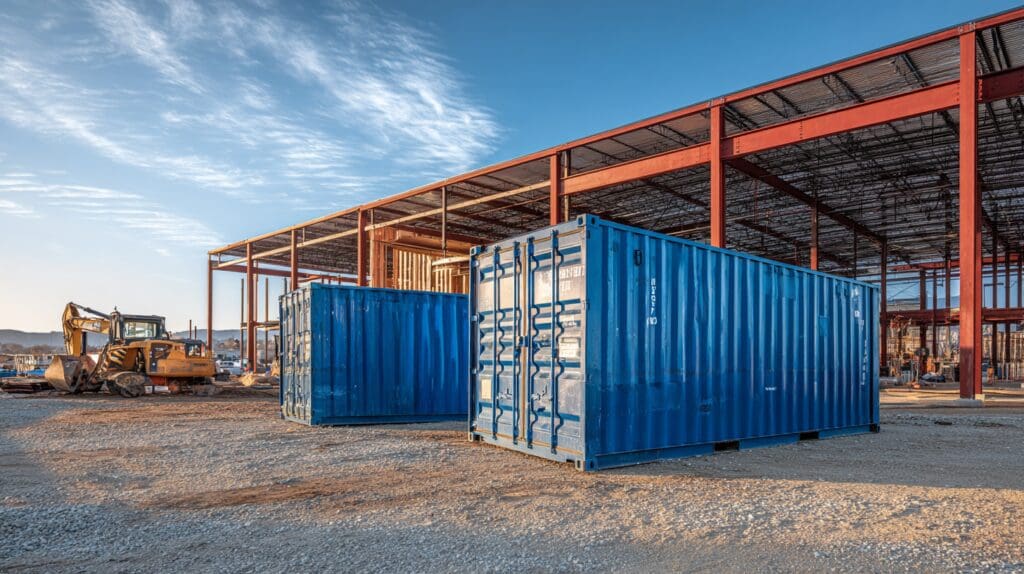
After a brief period of stability, construction material costs are heating up again in 2026. According to recent industry data, nonresidential construction input prices have surged more than 40% compared to pre-pandemic levels, with steel remaining one of the primary cost drivers. For contractors, small business owners, and developers who need secure storage or workspace, this renewed inflationary pressure is forcing a critical question: Is building from scratch still worth it?
For a growing number of professionals, the answer is increasingly “no”—at least not when shipping containers offer a faster, more affordable alternative.
The 2026 Steel Building Reality: What the Numbers Show
If you’re pricing out a small steel warehouse or workshop in 2026, prepare for sticker shock. Industry pricing guides show that basic steel building shells—the simplest prefabricated structures without interior buildouts—are averaging between $25 and $55 per square foot. That’s just for the shell. When you factor in foundation work, erection labor, permitting, site preparation, and interior finishing, total project costs can easily double or triple.
Consider a modest 2,400 square foot steel building (a typical 40×60 footprint). At the mid-range of current pricing, you’re looking at:
- Building shell: $84,000 – $132,000
- Foundation and concrete: $19,200 – $28,800 (at $8-$12 per sq. ft.)
- Professional erection: $24,000 – $48,000 (at $10-$20 per sq. ft.)
- Permitting, engineering, site prep: Variable, often $5,000 – $15,000+
Total realistic project cost: $130,000 to $225,000 or more—for what amounts to an empty box. And that’s before new tariff rounds add additional pressure to steel prices, which industry analysts warn may push costs even higher as 2026 progresses.
Why Contractors Are Rethinking the Traditional Approach
The math increasingly doesn’t work for many applications. Contractors bidding jobs need to store equipment, materials, and tools securely. Landscaping companies need seasonal storage. E-commerce businesses need micro-warehouse space for inventory staging. Agricultural operations need weather-resistant storage for feed, equipment, or supplies.
In all these cases, the question isn’t whether the storage needs to be permanent—it’s whether it needs to be perfect. And increasingly, the answer is that it needs to be practical, affordable, and fast.
This is where 40-foot shipping containers and their smaller 20-foot counterparts have emerged as a compelling alternative.
The Shipping Container Advantage: A Real-World Comparison
Let’s run the same scenario through a container-based approach. A standard 40-foot high-cube container provides approximately 320 square feet of secure, all-steel storage space. To match the 2,400 square feet of that hypothetical steel building, a contractor would need roughly 7-8 containers.
At current market prices, used shipping containers in good condition typically range from $2,000 to $3,500, while new or “one-trip” units run $3,500 to $5,000. Even at the higher end:
- 8 containers × $5,000: $40,000
- Delivery and placement: $2,000 – $4,000
- Site preparation (gravel pad, leveling blocks): $2,000 – $5,000
Total realistic cost: $44,000 to $50,000—roughly one-quarter to one-third the cost of a comparable steel building, with dramatically faster deployment.
But What About the Differences?
Fair question. Containers aren’t identical to purpose-built steel structures. They have different ceiling heights, door configurations, and aesthetic profiles. But for many practical applications, these differences are advantages, not drawbacks:
- Modularity: Need more space next year? Add another container. Need less? Sell one. Try doing that with a permanent building.
- Portability: Job site moves, business relocates, or lease ends? Containers move with you.
- Speed: Containers can be delivered and operational within days. Steel buildings take months from order to occupancy.
- Permitting: Many jurisdictions treat containers as temporary or accessory structures, significantly simplifying permitting requirements.
- Durability: Built from Corten weathering steel, shipping containers are designed to withstand ocean crossings, harsh weather, and decades of use.
Real-World Contractor Applications
How are contractors actually using shipping containers in 2026? Here are the most common applications:
Job Site Storage and Security
Construction sites are theft magnets. Tools, materials, and equipment left unsecured represent both financial loss and project delays. A shipping container provides theft-resistant storage that can be placed directly on site. Many contractors maintain a rental container that moves from project to project, eliminating the need for expensive tool trailers or off-site storage facilities.
Material and Equipment Staging
Contractors handling large-scale projects often need covered storage for materials awaiting installation—roofing supplies, HVAC equipment, and electrical components. Rather than leasing warehouse space or leaving materials exposed, containers provide secure, weather-resistant staging areas that can be positioned exactly where needed.
Satellite Operations and Mobile Workshops
General contractors working across multiple counties or regions sometimes find that maintaining a central shop isn’t practical. Container-based storage allows them to establish satellite operations closer to job sites, reducing travel time and fuel costs while maintaining secure equipment storage.
Specialty Storage Requirements
Some applications demand more than basic storage. Refrigerated containers serve food service contractors and agricultural operations. Insulated containers protect temperature-sensitive materials. Open-sided containers allow for easy loading and unloading of oversized equipment.
The Financial Equation Beyond Purchase Price
The upfront cost comparison tells only part of the story. Consider the broader financial implications:
Depreciation vs. Retention: Permanent buildings depreciate on fixed schedules and can’t be relocated if business needs change. Containers, particularly well-maintained units, retain significant resale value and can be sold when no longer needed.
Insurance Costs: Steel shipping containers are inherently fire-resistant, weather-resistant, and extremely secure. Many business owners find that insuring container-based storage is significantly less expensive than insuring traditional buildings or their contents left in less secure facilities.
Property Tax Implications: In many jurisdictions, permanent structures increase property tax assessments, while temporary or movable structures like shipping containers may not trigger the same increases. Consultation with local tax authorities is advisable, but this can represent meaningful ongoing savings.
Opportunity Cost of Capital: The $100,000+ difference between a steel building and a container solution isn’t just money saved—it’s capital that can be deployed elsewhere in your business. Equipment upgrades, marketing, additional inventory, or simply maintaining healthier cash reserves all have tangible business value.
Making the Decision: When Containers Make Sense
Shipping containers aren’t the right solution for every storage or building need. If you’re constructing a customer-facing retail space, a manufacturing facility with specific workflow requirements, or a building that needs to meet particular aesthetic or regulatory standards, traditional construction may still be the appropriate choice.
However, containers make compelling sense when:
- The primary need is secure, weather-protected storage
- Speed of deployment matters
- Capital efficiency is a priority
- Future relocation is possible or likely
- Scalability (up or down) is valuable
- The space won’t be used for permanent customer or employee occupancy
For contractors, construction companies, landscapers, and small businesses facing these criteria, the 2026 steel price environment has made containers not just a viable alternative, but often the smartest choice.
Getting Started
If you’re considering shipping containers for your storage needs, the process is straightforward. Giant Lock Box offers both new and used containers for purchase as well as rental options for shorter-term needs. With service across New York, New Jersey, Pennsylvania, Ohio, Connecticut, Rhode Island, and Texas, delivery and placement can typically be arranged within days.
Our tilt-bed delivery system, paired with a site walk before delivery day, lets us place containers at locations precisely where the truck can safely reach—and if a site won’t work, we tell you before you order rather than after.
Request a quote to get specific pricing for your location and container requirements. In the current construction cost environment, the numbers may surprise you.