
A single-wide job-site office trailer in the Northeast now rents for $250 to $700 a month, before a $1,000 to $5,000 delivery and setup fee that most first-time renters don’t budget for. More general contractors across New York, New Jersey, and Pennsylvania are skipping that fee this fall by buying and converting a shipping container into the office instead, and the math behind that shift only makes sense once you line the two options up side by side.
This isn’t a universal answer. Renting still wins on plenty of short jobs. But the crossover point is closer than most contractors assume, and it depends on how long the job runs, how many sites the office moves to next, and what happens to the box when the project wraps. Our overview of shipping container customization covers the build process end to end; this piece runs the actual numbers against renting.
What a Job-Site Trailer Costs in the Northeast This Fall
A standard 8-by-20 single-wide trailer, small enough for a superintendent’s desk and a plan table, runs $150 to $400 a month, according to 2026 rental-market pricing data compiled by The Site Savvy. The size most general contractors actually order, a 10-by-40 or 12-by-40 single-wide with room for a small team, runs $250 to $700 a month as of this fall. A 24-by-60 double-wide with a conference room and a second office climbs to $700 to $1,800 a month.
None of those numbers include getting the trailer to the site. Delivery, blocking, leveling, anchoring, and steps run $1,000 to $5,000 combined, and removal at the end of the job is billed separately as its own transport charge. Lead time on a stock trailer averages 7 to 10 days; a custom configuration during peak season can take several weeks, and many rental companies enforce a 3-month minimum regardless of how long the job actually needs the unit.
Coastal Northeast markets run above the national range in that pricing data, and site conditions push costs higher fast. Soft ground, a slope, or a tight access lane all add to the delivery and setup line before the trailer even opens for business.
How Much Does It Cost to Convert a Shipping Container Into a Job-Site Office?
A basic 20-foot container office, with one door, two to three windows, insulation, and electrical, runs $15,000 to $25,000 complete as of 2026. Conexwest’s 2026 container modification cost breakdown puts spray-foam insulation at $2,000 to $4,500, a mini-split HVAC system at $1,500 to $3,000, and electrical service and wiring at $3,000 to $7,000, with the rest going to the windows, door, and the container itself. On a Bergen County contractor who ordered a 20-foot cargo-worthy unit this August with insulation, one mini-split, a service panel, and two windows, the finished number landed at $17,400, near the low end of that range because the shell was already wind-and-watertight before the build-out started.
Scale up and the per-foot economics improve. A 40-foot version with the same package runs closer to $28,000 to $34,000 once you add a second mini-split and more electrical runs, but it holds two full workstations plus a plan table and still arrives on one trip. The container itself is the smallest line on that invoice. A used 20-foot cargo-worthy unit averages $1,786 nationally as of September 2026, per Container Management’s cost guide, with delivery running another $350 to $850 within 100 miles of the depot.
Where the Math Flips: Rent Versus Own by Project Length
We’ve delivered and outfitted close to a dozen 20-foot cargo-worthy units as job-site offices for Northeast general contractors this construction season, most wired for a service panel, one mini-split, and a coffee station for $16,000 to $19,000 all-in. Line that up against a comparable 10-by-40 trailer at $475 a month, the midpoint of the Northeast range, plus a $2,500 average delivery and setup fee, and a rented office costs about $3,000 up front and then $475 every month after.
Run that out and the trailer stays cheaper for roughly the first 40 months, a little over three years, before total rental spend catches up to a $19,000 conversion. That’s longer than most single jobs run, which is the honest answer nobody selling containers likes to give first: on a one-year job, renting usually wins on raw cost.
The case for converting isn’t project length. It’s what happens between projects. A general contractor running four or five jobs a year moves the same owned office from site to site with no new delivery fee, no return inspection, and no damage deposit, plus lockable storage for tools between moves. Rent that same coverage four times over and the delivery and setup fees alone start to rival the conversion cost. Owning also leaves you with an asset; renting leaves you with nothing but a paid invoice.
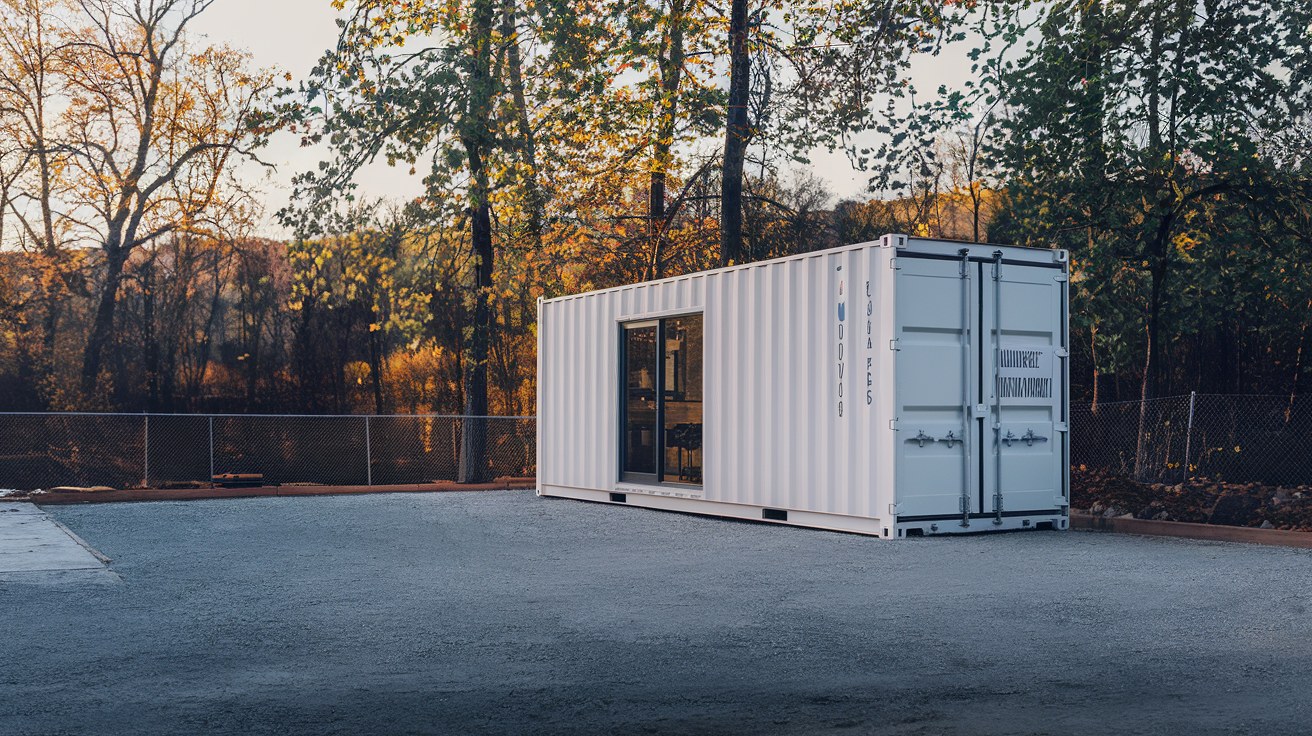
What Actually Goes Into a Modification-Ready Job-Site Office
The build order matters more than the parts list. Insulation goes in before electrical, because running wire through foam board after the fact means cutting channels that get patched later instead of built right the first time. A vapor barrier under the insulation matters especially in a Northeast fall, when a closed container’s interior can swing enough overnight to sweat condensation onto anything left unprotected.
Roll-up doors replace the standard cargo doors when the office also needs to double as tool storage, and a keyed man-door goes in beside it for daily foot traffic. Our modification options page runs through the full menu, roll-up doors, insulation packages, windows, HVAC, electrical, and paint, and most job-site office builds use five or six of those in combination.
Sizing follows the crew, not the budget. A 20-foot unit, with the exact interior clearances laid out here, fits a desk, a plan table, and a small seating area. Once a project needs a second desk or a break area, the jump to a 40-foot high cube buys standing headroom along with the extra floor. Whichever size you land on, ordering a cargo-worthy grade rather than wind-and-watertight matters more here than on a pure storage unit, since a job-site office needs a tighter shell before insulation and electrical go in.
Are Container Job-Site Offices Allowed on Every Northeast Site?
Most Northeast towns require the same temporary-structure or zoning permit for a converted container office that they already require for a rented trailer, and it runs through the local building department rather than a state DOT office. The International Code Council’s International Building Code treats both as temporary structures subject to local adoption and enforcement, which is why the permit path tracks whatever a municipality already has on the books for trailers. On a commercial job in Westchester County this summer, the town signed off on a 20-foot container office under the same temporary-structure permit it uses for construction trailers, a process that added about two weeks to the schedule and cost less than the first month of a trailer rental would have.
Two things change the answer. A container office that stays past the length of a temporary permit, common on a job running multiple years or a site the contractor owns outright, can trigger a permanent-structure review with its own foundation and egress requirements. And a site with restrictive covenants, historic-district rules, or an HOA overlay may restrict exterior appearance regardless of what the building code allows. Check with the local building department before ordering, the same step our delivery and placement guide recommends before any container hits the site, whether it’s headed for storage or an office build-out.
Security is the other variable a rented trailer doesn’t solve as well. A steel container with a locking-rod cargo door and a padlock box is harder to force than a trailer door, and our security features guide covers the locking hardware and grade differences that matter most for a job site holding tools and equipment overnight.
The Bottom Line
Renting wins the pure cost math on a single job under about three years. Owning wins on anything reused across multiple sites, whether that’s four job sites this year or a permanent yard office that outlasts the crew that built it. The honest version of this decision has nothing to do with which option we sell and everything to do with how many times the office moves before the job’s done.
Run your own numbers this week. Pull a rental quote for the trailer size the next job needs, then price a comparable used cargo-worthy container and modification package against it. If the job runs past three years, or the office gets redeployed more than twice, the container usually wins.
We quote job-site office conversions on 20-foot and 40-foot units delivered across New York, New Jersey, and Pennsylvania, insulation and electrical included. Request a quote today.
Note: we use AI to help draft market-analysis pieces like this; a team member edits every article before it publishes.
Sources: The Site Savvy, Mobile Office Trailer Rental Cost: Sizes, Fees & Factors (2026 pricing data); Conexwest, How Much Does It Cost to Modify a Shipping Container? (2026 cost breakdown); Container Management 2026 cost guide and 2026 delivery cost data; International Code Council, International Building Code.