
Albany’s average first frost date of October 7 and Hartford’s of October 10 have already passed, and Boston and Providence follow on October 27 and 28, per the 1991 to 2020 NOAA climate normals compiled by the Farmers’ Almanac. A buyer who wants a container on the ground before spring has a few weeks to finish the pad, because gravel is hard to spread and compact once the soil freezes.
Below are the frost dates for the major Northeast cities, how frost depth is set for your address, whether a container needs a frost-protected foundation under the model building code, what a pad built for winter looks like, and four steps to finish before delivery. Our shipping container delivery and placement guide covers the clearance and access checks that sit alongside the pad work.
When Frost Reaches Each Northeast City
The Farmers’ Almanac table, built on 1991 to 2020 NOAA climate normals, puts the average first frost (a reading of 32°F) at Albany on October 7, Hartford on October 10, Boston on October 27, Providence on October 28, Philadelphia on November 6, and New York City on November 11. The same article notes that a town’s date can differ from the nearest large city by two to three weeks, so a lot on higher ground can freeze well ahead of the figure for the city nearby.
First frost is an air-temperature reading. The ground freezes later, after sustained cold, which is why late October and November are the working window for grading and gravel across most of the region. In our experience, a pad finished after the ground has frozen is the most common reason a late-fall delivery slips to spring. Gravel does not compact on frozen ground, and a unit set on a base that has not been finished can settle unevenly once the thaw arrives.
How Deep Is the Frost Line Where Your Container Will Sit?
Frost depth is set address by address in the climatic table of your local building code, and values across the Northeast commonly run from about 36 inches to 48 inches or more, rising toward the north. The Connecticut Office of the State Building Inspector applied a 42-inch frost depth from Table R301.2(1) in its October 2005 interpretation I-12-05 on footings for unheated garages. In that interpretation, a garage cold enough to freeze the soil under its slab needed footings below 42 inches unless it was a freestanding structure of 400 square feet or less with an eave height of 10 feet or less.
Your building department can give you the number for your town in one phone call, and the same call settles whether your town treats a container as an accessory structure. Frost heave lifts anything that sits above the frost line, and it lifts unevenly, which can leave a container racked enough that its doors bind.
Does a Shipping Container Need a Frost-Protected Foundation?
A shipping container used for storage often does not need a frost-protected foundation, because the model residential code exempts freestanding accessory structures of 400 square feet or less with an eave height of 10 feet or less. That exemption sits in Section R403.1.4.1 of the 2012 International Residential Code, which requires foundation walls, piers, and other permanent supports to be protected from frost unless an exception applies. A 20-foot container covers about 160 square feet and a 40-foot high-cube about 320 square feet at 9 feet 6 inches tall under ISO 668 dimensions, so both sit under the numbers, and the Connecticut inspector’s office applied the same 400-square-foot cutoff to a freestanding garage in 2005.
Three limits apply. Your state and town adopt their own code edition and amendments, so the cutoff in your jurisdiction may differ. A container stacked, joined to a building, or fitted out with utilities gets a different review. A container that becomes living space moves the foundation question to an engineer and the building department, and our look at alternative living spaces built from shipping containers covers what that path involves.
What a Winter-Ready Container Pad Looks Like
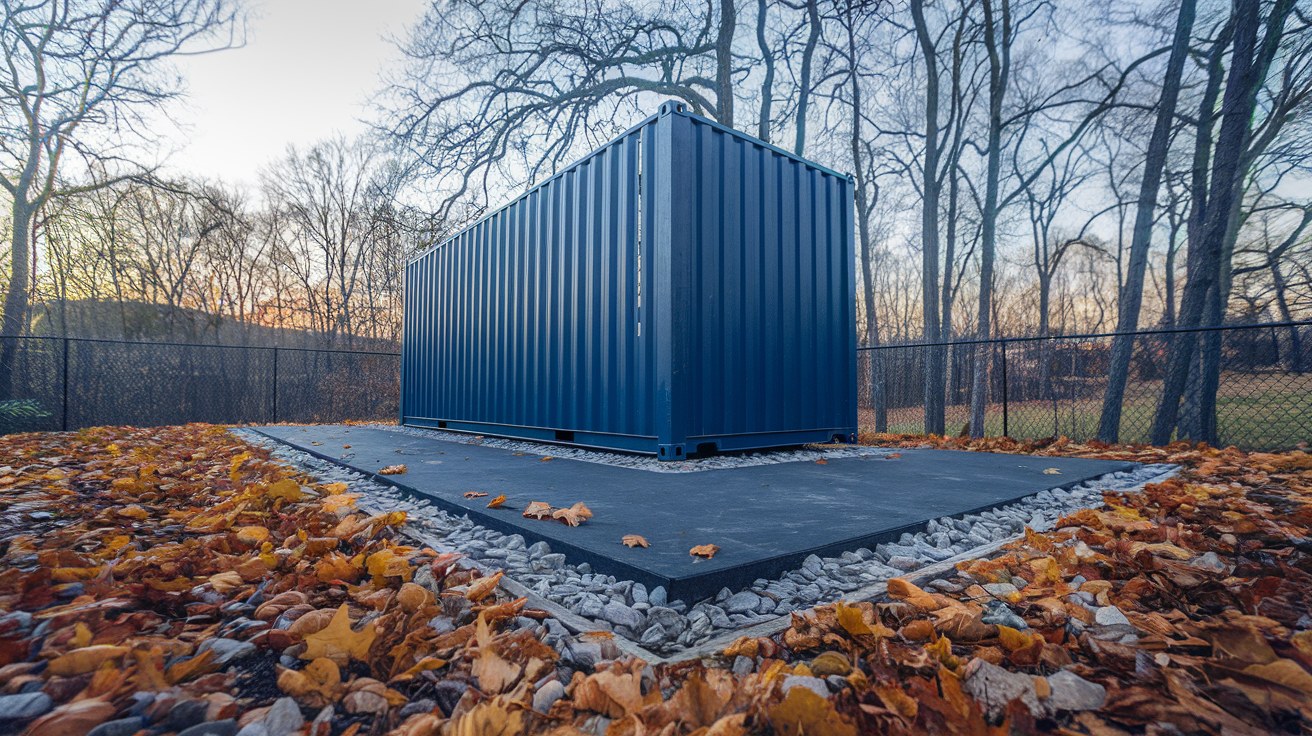
Contractor guides agree on the basics of a base: gravel on graded ground that is flat and drains. Falcon Structures recommends a gravel pad for any unit that stays in one place for a month or more, a grade under 2 percent, and a monthly check for sinking or tilting, and it describes a simple pad as three inches of gravel. A June 2026 pad-preparation guide published by Resident calls for excavating about 15 centimeters (roughly 6 inches), filling with clean angular gravel compacted into a dense layer, and laying geotextile fabric beneath it.
ConexWest notes that frost-prone or wet areas may require stronger or deeper foundation planning, and that is the case across most of the Northeast. Treat three inches as the floor for a flat, dry lot with good soil, and ask a local contractor or engineer to size anything wetter. Falcon also points out that a container’s weight rides on its corner castings, and the Resident guide places concrete piers or steel footings under all four corners at the same elevation so the frame does not twist. Leave room on every side for water to move away from the pad, since meltwater that pools under a base is what freezes and heaves.
Four Steps to Finish Before Delivery
**First, call your building department.** Ask for the frost depth at your address, whether a container counts as an accessory structure, and whether a permit applies. Write the answers down before you order. Our overview of using shipping containers for storage covers the common storage setups that tend to qualify for the lighter review.
**Second, measure and stake the pad.** Use the footprint of the unit you plan to buy, plus space at the door end for the doors to swing and a margin on each side for drainage. Our reference on shipping container dimensions lists external and internal sizes and door openings for each type.
**Third, build the base before the ground freezes.** Grade the site, lay fabric, spread and compact the gravel, and check level across both diagonals. The Resident guide uses diagonal measurements to confirm that no corner sits higher or lower than the others.
**Fourth, photograph the approach and measure it.** Gate width, overhead clearance, and turning room decide whether a delivery takes one visit or two. A level, stable base also helps the doors close squarely, and our write-up on the security features of shipping containers explains why door alignment matters for the locking rods.

The Bottom Line
A storage container in the Northeast often does not need a frost-protected foundation under the model code’s 400-square-foot exemption, but it does need a flat, drained, compacted base, and that base has to be finished before the soil freezes. Albany and Hartford crossed their average first frost dates in the first ten days of October, Boston and Providence cross theirs within the next two weeks, and New York City follows on November 11.
Your step this week costs nothing. Call your building department and ask three questions: the frost depth for your address, whether a container counts as an accessory structure there, and whether a permit is required. Then stake the corners of the pad and measure the diagonals.
We can match a unit to your site and tell you the earliest delivery date once the pad is ready, with used containers and 20-foot units delivered across New York, New Jersey, and Pennsylvania. Request a quote today.
A note on how this article was written: we use AI to help draft and research pieces like this, then a Giant Lockbox team member edits for accuracy and voice. Here’s how and why we use AI in our content.
Sources: Farmers’ Almanac, First Frost Dates 2026, based on 1991 to 2020 NOAA climate normals; International Code Council, 2012 International Residential Code, Section R403.1.4.1; Connecticut Office of the State Building Inspector, Building Code Interpretation I-12-05 (October 17, 2005); Falcon Structures, shipping container foundations guide; Resident, guide to preparing a level ground foundation for 20-foot shipping containers (June 11, 2026); ConexWest, guide to materials under shipping containers; ISO 668 container dimensions.