
A shipping container has to be delivered and ready for business use by December 31, 2026 to count toward a 2026 Section 179 deduction, and a new one-trip unit that has not yet left a Chinese factory will miss that date more often than it makes it. Thirteen weeks remain as of September 29. The 2026 dollar limit of $2,560,000 sits far above any storage purchase, so the constraint for a container buyer is the delivery date.
We sell containers and do not give tax advice, so every rule below is attributed to its source and your CPA makes the final call. What follows covers the 2026 limits, whether a container qualifies, how long a new unit takes to arrive, what the IRS means by placed in service, and how modifications can change the tax class. Our running read on the trends shaping the container sales industry has tracked new-build supply and used-yard supply moving on separate clocks all year, and that split decides who can still buy in 2026.
What the 2026 Deduction Limits Allow
The 2026 Section 179 limit is $2,560,000, and it shrinks dollar for dollar once a business places more than $4,090,000 of qualifying property in service, per Section179.org’s 2026 summary of the IRS figures. The deduction disappears entirely at $6,650,000. IRS Publication 946 adds that the One Big Beautiful Bill Act (Public Law 119-21) restored a 100 percent special depreciation allowance for qualifying property acquired and placed in service after January 19, 2025, so first-year expensing has two routes in 2026.
Three limits matter more to a container buyer than the headline number. The deduction cannot exceed taxable income from the active conduct of a business, and any disallowed amount generally carries forward, according to Section179.org’s FAQ. The business must use the property more than 50 percent of the time, per IRS Publication 946. Used equipment qualifies when it is new to your business and comes from an unrelated seller, which matters here because most Northeast storage buyers purchase used cargo-worthy units.
The dollar amounts in a container purchase are small next to those limits. A used 20-foot unit averages $1,786 nationally as of September 2026 per Container Management’s cost guide, and delivery within 100 miles of a depot adds $350 to $850. At a 24 percent federal bracket, a $2,400 delivered unit that is fully expensed reduces federal tax by roughly $576. That is arithmetic for illustration, so run your own bracket with your preparer. Our guide to affordable buying paths covers where used pricing lands by grade.
Does a Shipping Container Qualify for Section 179?
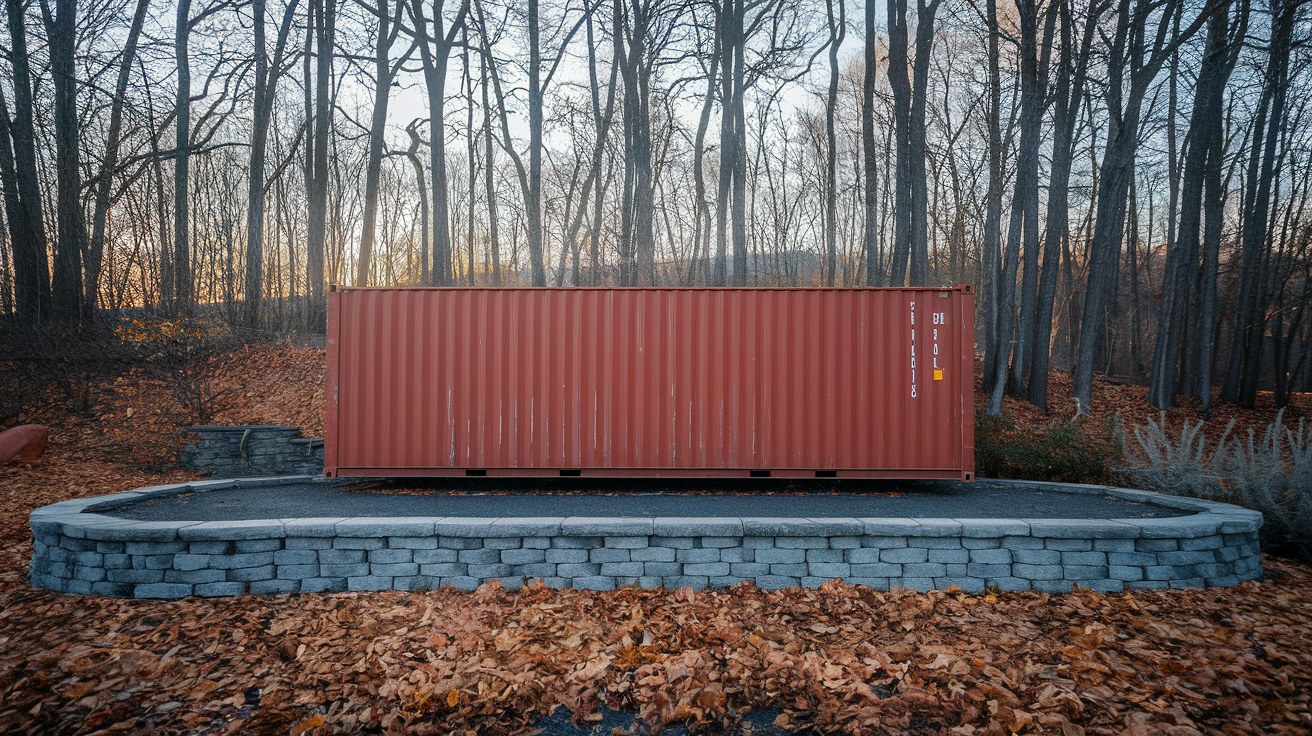
A shipping container bought for business storage generally qualifies as tangible personal property for Section 179 when the business uses it more than 50 percent of the time. IRS Publication 946 sets that business-use test and excludes buildings and their structural components, while LegalClarity’s depreciation guide places trailers and trailer-mounted containers in asset class 00.27 with a seven-year recovery period. A typical case is a landscaping company that buys a used 20-foot unit to hold mowers and hand tools on its Bergen County yard, where the box sits on a pad, holds business equipment, and has no permanent connection to the ground or to utilities.
Section 179 covers new or used equipment, and a true lease generally does not qualify because you do not own the asset for tax purposes, per Section179.org. Financing generally preserves eligibility. Rent-to-own arrangements vary, so bring the contract to your preparer before you sign. Our inspection checklist covers what to verify on the unit itself, and our overview of using shipping containers for storage covers the business uses that hold up.
Can a New One-Trip Container Ordered Now Still Arrive by December 31?
Only in a best-case sequence, because a factory-built unit ordered this week needs roughly nine to ten weeks to reach a Northeast site once China’s Golden Week is counted, which lands between December 1 and December 8. Spinnaker Equipment’s 2026 guide to storage container delivery lead times puts order-to-deployment at six weeks to four months, and World Class Shipping’s data puts the East Coast ocean leg alone at 25 to 35 days port to port before customs and inland trucking. For a buyer who orders on October 1, a four-month lead time means an early February delivery, a month after the tax year closes.
The calendar works against the order. SEKO Logistics’ 2026 Golden Week guide counts three working days between the Mid-Autumn Festival holiday on September 25 to 27 and National Day, October 1 to 7, and Dachser’s advisory says operations do not snap back on October 8 because a week of orders is waiting. Xeneta’s September 18 update put Far East to US East Coast spot rates at $11,259 per 40-foot container on September 17, 11.2 percent below the January 2022 record, with carriers adding East Coast capacity and softening expected two to three weeks after Golden Week. A buyer with a tax deadline cannot wait for softer freight rates and a later delivery date.
Northeast yard stock runs on a different clock. Units already sitting in a Northeast depot ship in days, and that inventory is what a year-end buyer should be shopping. Our overview of the different types of shipping containers covers how one-trip, cargo-worthy, and wind-and-watertight units compare, and our guide to where to buy used shipping containers covers which sellers will name the depot a unit is sitting in before you pay.
What Does Placed in Service Mean for a Container?
Placed in service means the container is ready and available for its specific business use, and delivery alone may not meet that test. IRS Publication 946 defines the term as ready and available for a specific use and treats a delivered machine as placed in service only after installation leaves it ready to operate. For a container, ready means resting on a level pad with doors that open and business equipment inside, so a unit that arrives December 29 and cannot be set because the pad is soft raises a real question about which tax year it belongs to, and that question is one for your preparer.
In our experience the year-end calls start in the second week of November, and by then the buyers who need delivery before December 31 are choosing from whatever is on the ground rather than whatever they specified. The units that make it are the ones with a finished gravel pad, a clear approach, and a gate wide enough for the truck, all confirmed before the order is placed. A failed delivery usually costs the delivery charge a second time, which is $350 to $850 within 100 miles of a depot per Container Management, and a second attempt in the last week of December may not fit the calendar at all.
Ground conditions add risk this winter. NOAA’s Climate Prediction Center is forecasting a strong El Niño for the winter of 2026 and 2027, which favors warmer and wetter than normal weather across the Northeast, and the center’s official outlook publishes in mid-October. On unpaved sites that means mud days in place of the frozen ground many Northeast deliveries count on. Our delivery and placement guide covers the pad, clearance, and access checks, and your local building or zoning office can tell you whether the placement needs a permit.

Does Adding Insulation and Electrical Change a Container’s Tax Class?
It can, because a container converted into a permanent office, shop, or dwelling may be treated as a building instead of equipment, and buildings fall outside Section 179. IRS Publication 946 excludes buildings and their structural components but allows an election for qualified improvements to nonresidential real property, such as roofs, HVAC, fire protection, alarm, and security systems, placed in service after the building itself, and LegalClarity’s depreciation guide describes the dividing line as how permanently the container is attached and whether it has been adapted to a use inconsistent with its original function. A contractor who buys a used 20-foot unit for tool storage and later adds insulation, a service panel, and a mini-split to make it a field office, a conversion that runs $15,000 to $25,000 complete as of 2026 per Conexwest, may see the finished asset sorted differently from the bare box.
LegalClarity’s guide sorts a container converted into a dwelling as 27.5-year residential real property and one converted into a permanent office, retail space, or warehouse as 39-year nonresidential real property. Those are much longer recovery periods than the seven years for a portable storage unit. Many buyers separate the two purchases, so the storage unit is in service by year-end while the conversion gets scoped with a preparer first. Our pages on modification options and the customization process list what each add-on involves, which helps you describe the work accurately to your CPA.
The Bottom Line
A container purchase counts toward a 2026 deduction only if the unit is in service by December 31. New factory orders placed from here mostly become 2027 assets, while Northeast yard stock is still 2026 inventory.
Your step this week costs nothing. Send your preparer three questions: whether your business income supports the deduction, whether the unit you plan to buy is treated as equipment, and whether any modification changes that answer. Then ask the yard which units in your size sit in a Northeast depot today and what date they can be set on a finished pad. A buyer with a graded pad and answers to both by the end of October has two months of margin.
We can tell you which depot a unit is sitting in and the earliest delivery date to your site, with used containers and 20-foot units delivered across New York, New Jersey, and Pennsylvania. Request a quote today.
A note on how this article was written: we use AI to help draft and research pieces like this, then a Giant Lockbox team member edits for accuracy and voice. Here’s how and why we use AI in our content.
Sources: IRS Publication 946, How to Depreciate Property (2025); Section179.org, 2026 Section 179 Deduction and Section 179 FAQs; LegalClarity, What Is the Depreciable Life of a Shipping Container?; Container Management 2026 cost guide and delivery cost data; Spinnaker Equipment, Storage Container Delivery Lead Times 2026; World Class Shipping, China to USA ocean freight lead times; SEKO Logistics, Golden Week China 2026 Supply Chain Guide; Dachser, Plan Ahead for China’s Golden Week 2026; Xeneta Weekly Ocean Container Shipping Market Update, September 18, 2026; NOAA Climate Prediction Center winter 2026-2027 outlook; Conexwest, How Much Does It Cost to Modify a Shipping Container? (2026).