
Newark’s normal overnight low falls from 65°F on September 1 to 55°F by September 30, per the National Weather Service’s 1991 to 2020 climate normals, and that slide is when water starts appearing on the ceiling of shipping containers packed during a humid summer. This year the setup is worse than usual. NOAA’s National Centers for Environmental Information (NCEI) recorded summer 2026 as the warmest on record for the contiguous United States, and New Jersey took in more than 50 percent above its average August rainfall. A container that was loaded in July or August closed its doors on some of the wettest, warmest air the region has seen in years.
If you store tools, inventory, furniture, records, or feed in a steel box, the next six weeks decide whether that air stays harmless or ends up dripping onto your stuff. Most of the problem can be fixed for less than the cost of one ruined pallet of cardboard. Below is why fall is the trigger, how much water is actually involved, how to tell condensation from a leak, and the fixes ranked from cheapest to most permanent. Our overview of using shipping containers for storage covers the broader case for steel storage; this piece covers the one seasonal problem that catches owners off guard.
What the September Numbers Show
NCEI’s August 2026 national climate report puts meteorological summer (June to August) 0.4°F above the previous records set in 1936 and 2021, and August alone was the warmest August in the 132-year record. The same report shows New Jersey, Illinois, and West Virginia each receiving more than 50 percent above their normal August precipitation, and NOAA’s Climate Prediction Center favored above-average September precipitation for parts of the Northeast.
Then the nights turn. The National Weather Service’s Newark almanac shows the normal daily high dropping from 82°F to 72°F across September, while the normal low drops from 65°F to 55°F. NCEI’s first-freeze maps put the Northeast’s first freeze between mid-September and early October, and earlier than that farther north and inland. In Sullivan County or the Poconos, a container can see frost on the roof before October arrives.
Warm, wet air got sealed into containers all summer, and the steel walls around that air are about to get cold every night.
Why Does a Shipping Container Sweat When Fall Nights Turn Cold?
A shipping container sweats because the steel roof and walls cool below the dew point of the air trapped inside, and the water in that air condenses on the coldest surface. The German Insurance Association’s Transport Information Service (TIS), a cargo-loss reference published for marine insurers, states that condensation forms whenever cold surfaces meet warm, moist air, and that it is most severe on the underside of the container roof. On a New Jersey storage container closed up on an 80°F August afternoon at 70 percent humidity, the air inside has a dew point near 69°F, so every September night that drops into the 50s pushes the ceiling well past that line.
We ran the arithmetic from standard saturation tables. That August air holds about 17.7 grams of water per cubic meter. At 55°F, air can hold about 11.2 grams. A standard 20-foot container has roughly 1,170 cubic feet (33 cubic meters) of interior space, so the excess comes to around 215 grams of water, just under a cup, in a single cold night. A 40-foot high-cube, at about 76 cubic meters, sheds close to a pint. DESICCANT A/S, a Danish desiccant manufacturer, published a similar calculation in February 2026 for a humid Asian export container arriving in a cooler port and got more than a liter.
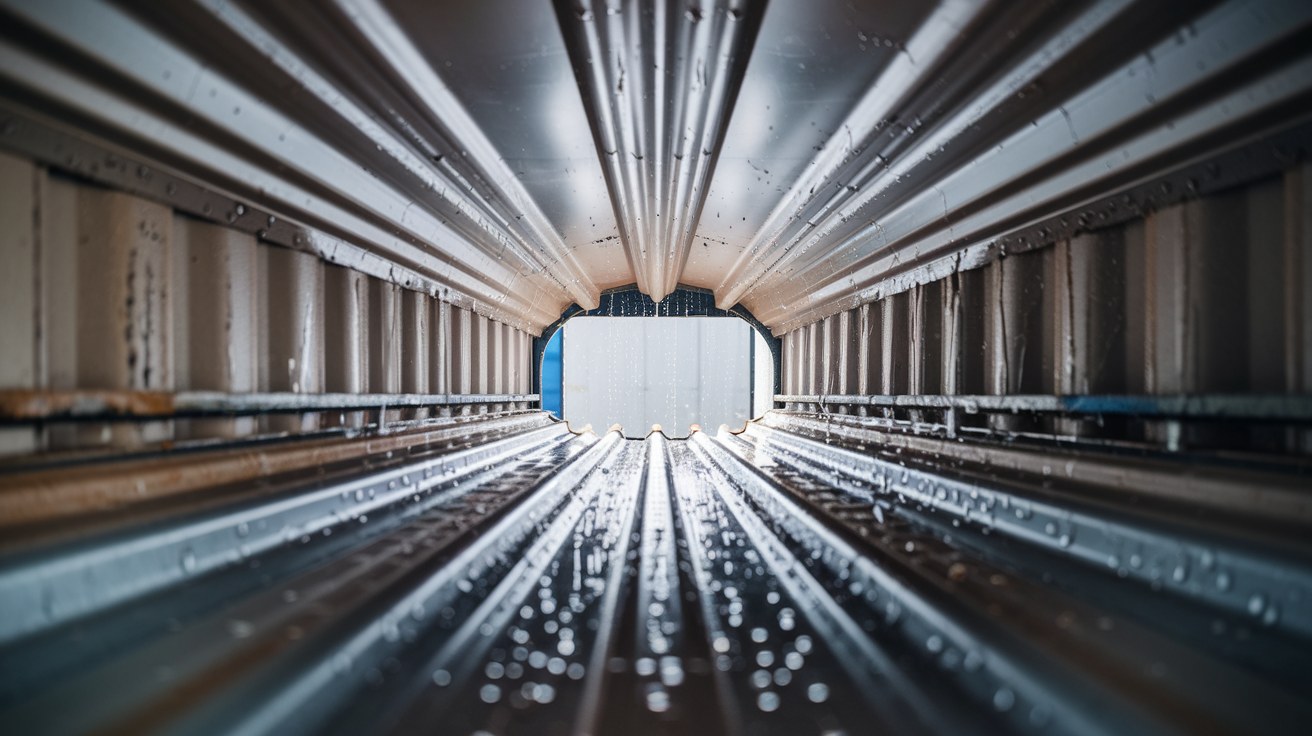
The steel makes it worse in both directions. TIS measurements show that on a 77°F day, the air inside a brown-painted container reaches about 122°F, and even a white container reaches about 100°F. That daily heat drives moisture out of cardboard, wood, and the container’s own plywood floor, and the cold night pulls it back out of the air onto the roof. TIS notes that roof condensation often does not dry out during the day, so the water builds up night after night until it drips.
What Condensation Does to Stored Contents and the Steel
The damage pattern is predictable. Cardboard cartons soften and collapse under stacked weight. Paper records cockle and grow mildew. Hand tools and fasteners can pick up surface rust after a few wet nights. Upholstered furniture and mattresses are the worst case, because they absorb water and hold it against the fabric long enough for mold to start.
The container itself takes damage more slowly. Water that pools on the floor soaks into the marine plywood along the seams, and years of that shortens the floor’s life faster than any amount of foot traffic. Water sitting in the bottom rail corners speeds up corrosion in exactly the spots our used container inspection checklist tells buyers to check first.
In our experience, the first calls about a “leaking” container come in the last week of September and the first half of October, and most of them turn out to be condensation. The pattern repeats: water on the floor in lines that match the roof corrugations, no daylight through the steel, a unit that was packed with cardboard or damp wood during the summer, and doors that have not been opened in weeks. The container itself is usually sound, and the fix sits in how it was loaded and how it breathes.
Is It a Roof Leak or Condensation?
If the water appears after cold, clear nights and lines up under the roof ribs rather than under one spot, it is almost always condensation. The TIS container-climate guidance describes exactly that behavior: condensation collects on the ceiling and then drips onto the cargo below. On a Rockland County container holding landscaping supplies, water spread evenly along the roof line after a 50°F night points to condensation, while a single wet spot that shows up only after rain points to a pinhole or a failed seam.
Two checks settle it for free. First, stand inside on a sunny afternoon with the doors closed and look up. Any pinpoint of daylight is a leak. Second, tape a 12-inch square of aluminum foil tightly to the inside of the roof or upper wall and leave it overnight. Water on the room side of the foil means condensation. Water trapped behind the foil means moisture is coming through the steel.
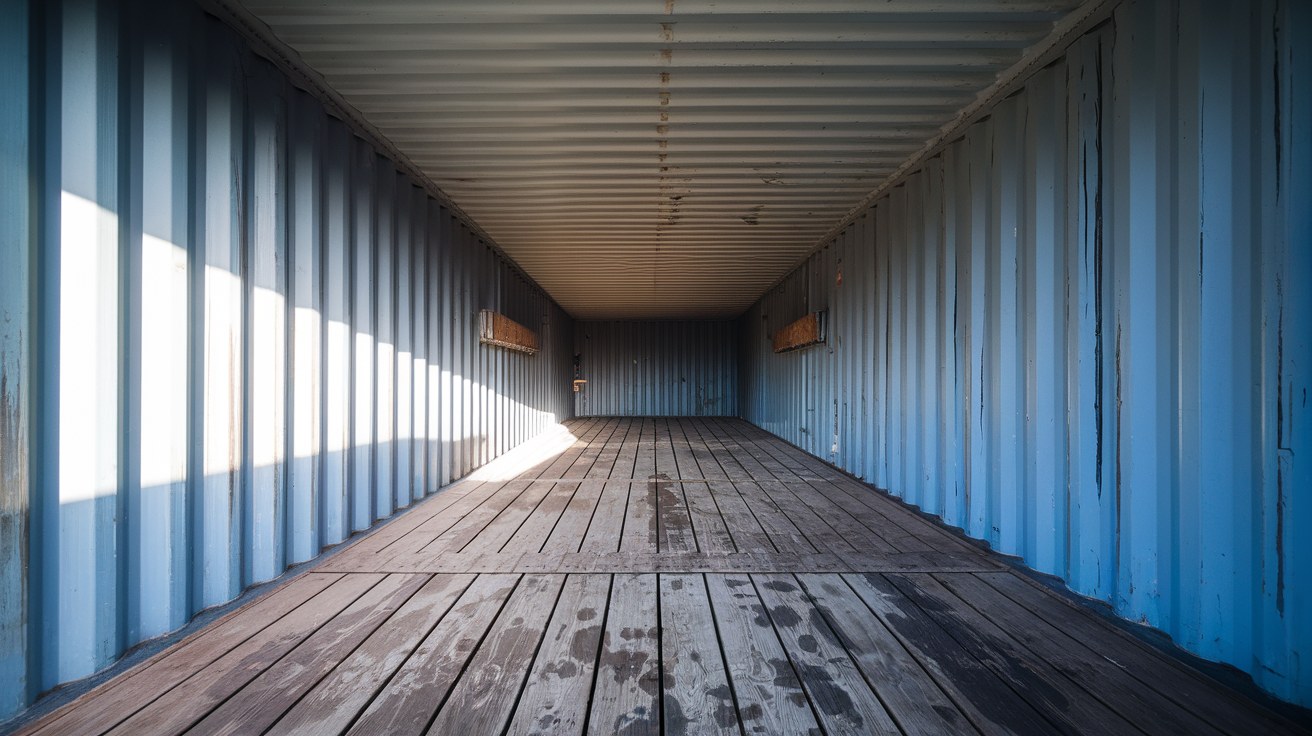
TIS also points out that standard containers are not fully vapor-tight, and wear around the door area is a common path for outside moisture. Worn door gaskets let wet air in every time the weather turns, which is one reason our guide to container security features treats the door seal and locking hardware as one inspection.
Fixes Ranked From Cheapest to Most Permanent
First, stop loading water into the box. TIS names the cargo, its packaging, and wooden flooring as the largest moisture sources in a closed container. Let tools and equipment dry before they go in, swap wooden pallets for plastic where you can, and keep cardboard off the floor on shelving or pallets. This costs nothing and does more than any product.
Second, add airflow. Standard containers come with a few small vents near the top rail, and those are not enough for a unit packed tight. Adding louvered vents high on opposite ends lets the humid daytime air leave before night falls. TIS notes that incoming outside air usually lowers the relative humidity inside, because the container is warmer than the air around it. Our write-up on container modification options covers vent placement alongside other add-ons.
Third, hang desiccants. Calcium chloride or clay desiccant bags pull water vapor out of the air before it reaches the roof. They are a seasonal consumable, so check them monthly through the fall and replace them when they fill. Pair them with the vents from the second step so the bags are not doing all the work.
Fourth, insulate the roof and upper walls. Closed-cell spray foam or rigid foam board slows how fast the ceiling cools at night, which keeps it above the dew point for more of the night. For long-term storage of anything that can mold, this is the permanent fix. Our explanation of how container customization works walks through the sequence, and factory-built insulated containers skip the retrofit step entirely.
Fifth, fix the site. A container set level on a gravel pad with good drainage stays drier than one sitting on bare soil in a low spot. Our delivery and placement guide covers pad prep, and it matters more in October than in June.
The Bottom Line
The Northeast’s September cooldown turns summer humidity into water on the ceiling, and a record-warm, wet summer loaded more of that humidity into containers than usual. The fix starts with what you put inside and how the box breathes, and ends with insulation if you store anything that can mold.
Your step this week takes ten minutes. Open your container on a sunny afternoon, close yourself in, and look for daylight. Then tape a square of foil to the ceiling and check it the next morning after a cold night. If it is condensation, pull the cardboard off the floor and let the unit air out with the doors open on the next dry day.
If you are shopping for a unit that will hold moisture-sensitive goods, we can quote vent and insulation packages on used containers or 20-foot units delivered across New York, New Jersey, and Pennsylvania. Request a quote today.
Note: we use AI to help draft market-analysis pieces like this; a team member edits every article before it publishes.
Sources: National Weather Service New York, NY, Newark NJ September Almanac (1991 to 2020 normals); NOAA National Centers for Environmental Information, Monitoring the U.S. Temperature and Precipitation in August 2026, September 9, 2026; NOAA NCEI, When to Expect the First Fall Freeze; German Insurance Association (GDV) Transport Information Service, Container Climate; DESICCANT A/S, Condensation Inside Shipping Containers: Why It Happens and How to Prevent It, February 10, 2026.