
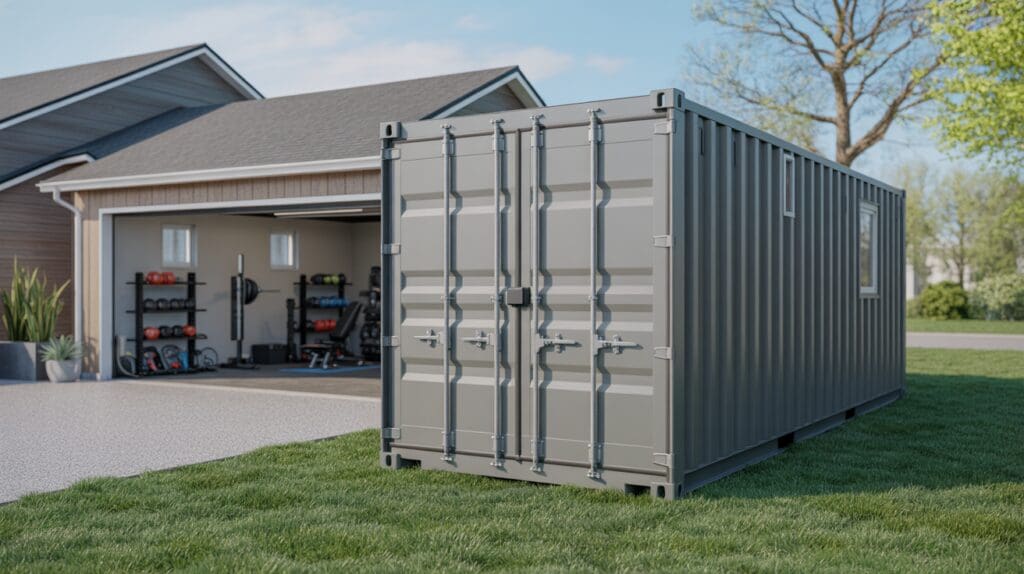
The American garage is getting a promotion. So is the basement. Across the country, homeowners are converting these once-forgotten spaces into home gyms, remote offices, guest suites, and finished entertainment areas. It’s one of the biggest residential design shifts of 2026—and it’s creating a storage crisis that most families don’t see coming until the drywall is already up.
The logic behind these conversions is sound. With the National Association of Home Builders (NAHB) forecasting a 3% increase in residential remodeling activity in 2026, mortgage rate lock-in effects are keeping homeowners in place longer, which means they’re investing in the homes they already own rather than moving. Garage-to-living-space conversions and basement finishes rank among the most popular ways to add square footage without pouring a new foundation.
But here’s the part that rarely makes it into the renovation plans: all the stuff that used to live in the garage or the basement still needs to go somewhere.
The Remodel Creates the Problem
Think about what a typical two-car garage actually holds beyond vehicles. Seasonal decorations. Lawn equipment. Power tools. Sporting gear. Camping supplies. Holiday bins. Paint cans. That one piece of furniture you’re going to refinish “someday.”
Now imagine that garage becomes a home office or a personal gym. Every single one of those items needs a new home—immediately.
The same thing happens with basement finishes. A family turns their unfinished lower level into a media room or playroom, and suddenly the old storage shelves, holiday décor, and off-season wardrobes have nowhere to go. The project that was supposed to make the home more livable actually makes it feel more cramped because the overflow has no outlet.
This isn’t a hypothetical scenario. NAHB data shows that the typical American home is now 41 years old, up from 31 years in 2006. These older homes often depend heavily on unfinished garages and basements as their primary storage zones. When those spaces get converted, the storage gap isn’t minor—it’s the entire household’s overflow capacity disappearing at once.
Three Homeowner Situations Driving the Shift
The Garage-to-Gym (or Office, or Workshop) Conversion
Garage conversions into living space have become one of the most cost-effective ways for homeowners to add functional square footage. Whether the goal is a dedicated home gym, a detached office for remote work, or a workshop with better climate control, the conversion typically costs far less than a traditional addition because the shell structure already exists.
The tradeoff is that the family loses its primary storage buffer. Yard tools, holiday bins, bicycles, and seasonal gear that once lined the garage walls now need to be relocated. Many homeowners don’t fully account for this displacement until they’re mid-project and realize they have nowhere to put 20 bins of Christmas decorations and a riding mower.
A 20-foot shipping container placed on the property can absorb nearly all of that displaced storage in a single delivery. With roughly 1,169 cubic feet of enclosed, weatherproof space, it holds the equivalent of a large garage’s worth of belongings—without interrupting the conversion project.
The Basement Finish That Eliminates the Storage Room
Basement remodeling trends in 2026 are leaning heavily toward multi-use spaces: home theaters that double as guest rooms, fitness areas with soundproofed walls, and remote workspaces with proper lighting and insulation. The design philosophy has shifted from “make the basement pretty” to “make the basement functional for daily life.”
The catch is that finished basements don’t leave room for storage zones. The cluttered shelving and stacked bins that once occupied the lower level get displaced when walls go up and flooring goes down. Families often discover mid-renovation that they need an interim storage solution just to clear the space for construction—and then a permanent one once the project is done.
For homeowners managing a basement renovation, renting a shipping container during the construction phase keeps belongings secure and accessible on-site. Many families then choose to buy the container outright when they realize the finished basement can’t absorb the overflow it once held.
The Declutter-and-Reorganize Household
Not every family is doing a full renovation. Some are simply trying to bring order to a home that has accumulated years of possessions. The 2026 garage organization trend emphasizes vertical storage systems, designated zones, and clutter-free layouts—all of which require reducing the total volume of items stored in the garage itself.
These homeowners face a choice: pay for off-site self-storage every month, or invest in an on-property solution that eliminates the recurring cost. According to SpareFoot’s industry data, one in three Americans currently uses self-storage, and the national average for a standard 10×10 unit sits around $119 to $133 per month. Over a year, that’s $1,400 to $1,600—and the meter never stops running.
A steel shipping container on your own property eliminates the monthly bill entirely. You pay once, and the storage is yours permanently. There’s no driving across town to access your belongings, no facility hours to work around, and no risk of rate increases.
Why Shipping Containers Solve the Problem Better Than Sheds or Portable Pods
When homeowners first realize they need overflow storage, they often consider three options: a backyard shed, a portable storage pod, or a shipping container. The differences matter.
Durability. Sheds are typically built from wood or lightweight metal and are vulnerable to moisture, pests, and weather damage over time. Shipping containers are built from Corten weathering steel that was designed to survive ocean crossings. They’re water-resistant, wind-resistant, rodent-proof, and fireproof—qualities that a standard backyard shed simply can’t match.
Security. A shed with a padlock offers minimal theft deterrence. A shipping container with a heavy-duty lock system is built to resist forced entry. For homeowners storing power tools, electronics, or high-value seasonal equipment, the security difference is significant.
Capacity. A standard 40-foot container provides approximately 2,390 cubic feet of enclosed storage—roughly equivalent to the storage capacity of an entire two-car garage. Even a 20-foot container provides more usable volume than most prefabricated sheds, and it arrives ready to use on delivery day.
Cost over time. A well-built shed can cost $5,000 to $15,000 or more and may need repairs or replacement within 10 to 15 years. A portable storage pod from a rental company runs $100 to $250 per month with no ownership equity. A shipping container—purchased outright—costs a fraction of what you’d spend on a decade of off-site storage rentals, and it retains resale value if your needs change.
The Financial Case: Own vs. Rent
The math is straightforward. RentCafe’s January 2026 self-storage report found that national street rates averaged $133 per month, with significant variation by metro area. Coastal and high-demand markets run considerably higher.
At $133 per month, a family spending three years in off-site storage will pay nearly $4,800—with nothing to show for it at the end. Five years of off-site storage approaches $8,000. Ten years hits almost $16,000.
A quality used shipping container typically costs between $2,000 and $3,500, while a new or one-trip unit runs $3,500 to $5,000. Factor in delivery and site preparation, and the total investment is often recouped within the first 18 to 24 months compared to what you’d spend at a self-storage facility.
And unlike a storage unit you rent, a container on your property is accessible 24/7. No facility hours, no driving across town, no loading and unloading a truck every time you need a seasonal item.
Delivery and Placement Make It Easy
One of the most common concerns homeowners have about placing a container on their property is logistics. Giant Lock Box addresses this with a tilt-bed delivery truck and a careful, hands-on approach. We walk your site before delivery, plan the approach, and set the container exactly where the truck can safely reach on suitable, accessible ground. If your site won’t work for the unit you want, we tell you before you pay—no surprises on delivery day.
Each container is leveled with blocks to protect your property, provide air circulation underneath, and prevent animals from nesting beneath the unit. The process is fast, clean, and requires no preparation beyond having a reasonably accessible delivery path.
For homeowners in the middle of a renovation, this means the container can arrive the same week construction begins—keeping your belongings secure and out of the way while the garage or basement transformation takes shape.
Before You Convert, Plan for the Overflow
If you’re planning a garage conversion, basement finish, or whole-house declutter project in 2026, build your storage plan into the project timeline from day one. Waiting until the renovation is underway to figure out where everything goes adds stress, delays, and unnecessary expense.
Here’s a simple planning approach:
Inventory before you renovate. Walk through your garage or basement and catalog what’s stored there. Categorize items as keep, donate, and discard. The items in the “keep” category are what you’ll need to house elsewhere.
Size your storage need. A 20-foot container handles most single-garage overflows. If you’re clearing out a two-car garage or a full basement, a 40-foot container or a 40-foot high-cube gives you room to spare with the added ceiling height that makes stacking easier.
Decide rent or buy. If your overflow is temporary—just during the renovation—a container rental keeps costs low. If your conversion permanently eliminates your primary storage space, buying the container outright is almost always the smarter financial move.
Check local requirements. Container placement rules vary by municipality. Giant Lock Box can help you navigate the specifics for New York, New Jersey, Connecticut, Pennsylvania, Ohio, Rhode Island, and Texas. For New York homeowners in particular, it’s worth reviewing the 2025–2026 rules for shipping containers before placing an order.
The Bottom Line
The 2026 remodeling boom is real, and it’s producing better homes. But every garage conversion and basement finish removes storage space that the household depended on—and most families don’t plan for that loss until they’re surrounded by displaced bins and boxes with nowhere to put them.
A shipping container on your property solves the problem immediately, affordably, and permanently. It’s more secure than a shed, more cost-effective than off-site storage, and it keeps everything you own accessible on your own schedule.
Ready to reclaim your garage or basement without losing your storage? Request a quote from Giant Lock Box or call (845) 343-0700 to discuss rental and purchase options for your project.