
The construction industry has always run on people. Skilled people. And right now, there are not enough of them.
By every major industry measure, 2026 is shaping up to be one of the tightest labor years the U.S. construction sector has ever faced. According to the Associated Builders and Contractors, the industry needs to attract roughly 349,000 additional workers this year just to keep pace with existing demand — and some estimates push that number closer to half a million when you factor in large-scale infrastructure and data center pipelines. That gap is not a short-term blip. It reflects a structural reality: an aging workforce, persistently low enrollment in the trades, and project backlogs that show no signs of shrinking.
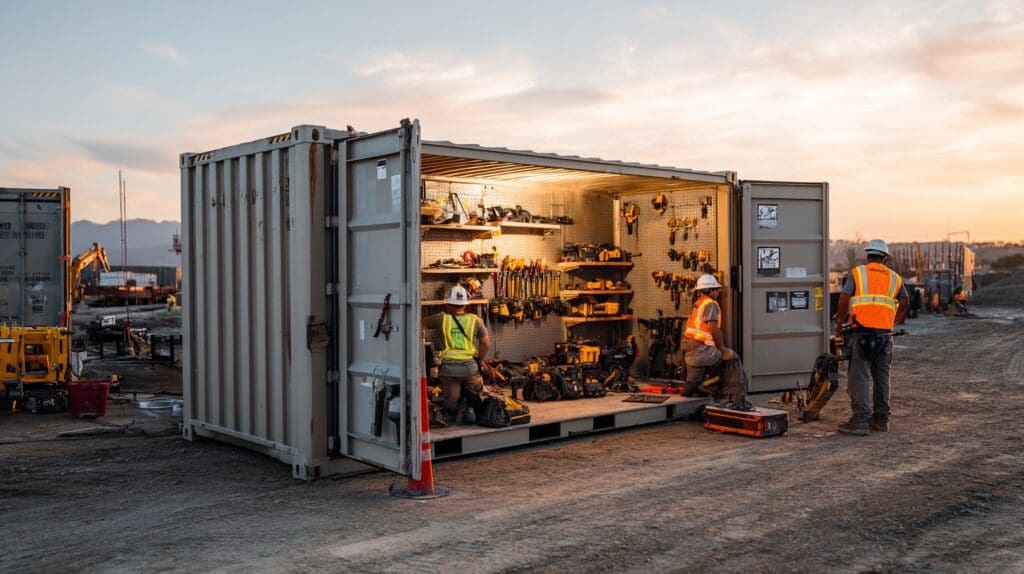
For contractors working with leaner crews, the math is unforgiving. Fewer hands on a job means every hour of labor carries more weight. Wasted motion — walking back to a truck, hunting for a misplaced tool, waiting on a delivery that should have been staged the day before — adds up fast when you are already short-staffed. That pressure is pushing a growing number of contractors toward a tool most people associate with shipping docks and freight yards: the intermodal steel shipping container.
Why Shipping Containers Make Sense Under Labor Pressure
The logic is straightforward. When a crew spends less time searching, walking, and restaging, it spends more time building. A well-organized jobsite is not just cleaner — it is measurably faster. And a shipping container, placed strategically on or near the work area, functions as a centralized productivity node in a way that a pickup bed, an open gang box, or a rental storage shed simply cannot.
Engineering News-Record, one of the construction industry’s most authoritative publications, has consistently noted that labor “relief” in recent months has masked deeper structural risks as demand continues to grow in key sectors. The implication for contractors is clear: efficiency improvements are not optional extras. In a market where you cannot hire your way out of a production problem, you have to organize your way out.
Steel containers address several of the core inefficiencies that plague understaffed jobsites at once.
Centralized tool and material storage. When everything a crew needs for the day — power tools, fasteners, PPE, consumables — is in one lockable, organized box rather than spread across three trucks and two supply runs, start times tighten and interruptions drop. A 40-foot container gives a mid-size crew enough room to stage tools, store materials, and keep a clean separation between what is in use and what is in reserve. For smaller crews or tighter sites, a 20-foot container hits the right balance between capacity and footprint.
Pre-staged component storage. Modular and prefabrication workflows are growing fast in part because they reduce the number of skilled decisions that have to happen on-site. Bluebeam’s analysis of the 2026 efficiency mandate frames prefabrication as one of the primary strategies contractors are adopting to extract more output from constrained crews. A container supports this directly: pre-assembled MEP racks, packaged tool kits, pre-cut framing components, and pre-staged materials can all be loaded the evening before and accessed the moment the crew arrives.
Reduced exposure to theft and weather damage. Understaffed sites often run lean on security as well as labor. A container’s corten steel walls, standard lockbox hardware, and weathertight seals protect inventory in a way no open flatbed or temporary shed can match. You can explore the full breakdown of those protections at Giant Lock Box’s security features overview.
Choosing the Right Container for a Jobsite Setup
Not all containers serve every site equally, and matching the right unit to the work conditions is part of what separates a well-run container setup from one that creates its own friction.
For active construction sites where tools and materials cycle in and out constantly, double-door containers offer a meaningful operational advantage. Being able to load from one end and pull from the other eliminates the shuffling that inevitably happens when a single-door unit becomes deep-packed over the course of a project. On sites where forklift access or side-loading is a priority, open-sided containers provide full lateral access without requiring everything to funnel through a single door opening.
For crews working in temperature extremes — summer heat on a Texas commercial site, winter conditions on a Northeast renovation project — insulated containers make a real difference both for material preservation and for worker welfare. Giving a two-person crew a climate-controlled place to take a 10-minute break in the middle of a 95-degree day is not a luxury. In a labor market where retention is as much of a problem as recruitment, the quality of the jobsite environment matters.
If you are deciding between sizes or configurations, the shipping container sizes guide walks through the key dimensions and capacity comparisons in detail.
Placement and Delivery: Getting It Right the First Time
One of the practical advantages Giant Lock Box’s tilt-bed delivery offers is precision placement. We walk the site with you and set the container on suitable, accessible ground where the truck can safely reach. On a tight urban site or a residential property with limited access, getting placement right the first time is not trivial — and if your spot won’t work, we’ll tell you before you pay.
Containers can also be leveled with blocks to protect the underlying surface, which matters both for the site owner and for keeping the container floor level when it is being used as a staging area. The shipping container delivery and placement guide covers site preparation, positioning options, and what to expect on delivery day.
For contractors who are managing multiple active projects simultaneously, the rental option offers a project-by-project approach. Instead of tying capital into owned units that sit idle between phases, a rented container can follow the work — brought in at mobilization, removed at substantial completion, and redeployed for the next project.
The Contractor Recruiting and Retention Angle
There is a subtler argument for well-organized jobsite storage that does not always get talked about directly: it signals professionalism, and that signal matters when you are trying to attract and keep workers in a tight labor market.
A chaotic site — tools scattered, materials disorganized, nowhere clean to stage work — communicates that the company does not have its act together. In a market where experienced tradespeople can afford to be selective about who they work for, that perception is a liability. Conversely, a site with a clearly positioned container hub, organized tool inventory, and a logical material flow sends a different message. It says the company plans ahead. That matters to the people you want on your crew.
The container setup also supports supervision efficiency when headcounts are low. A foreman managing a four-person crew instead of an eight-person crew needs to minimize the number of decisions being made in real time. A well-stocked, well-organized container means crew members can self-direct on material and tool retrieval rather than waiting for instruction or making a supply run.
The Homeowner Angle: The Weekend Command Center
Labor pressure is not exclusively a contractor problem. Homeowners tackling significant renovation or outdoor projects in 2026 are running into the same constraint in miniature: limited time, limited help, and a growing list of tools and materials to manage.
A 20-foot container in the driveway or side yard functions as a weekend command center — everything in one organized, lockable place. No more hauling tools from the garage to the backyard and back again. No more tarping materials that should have been stored properly. The container becomes the organizational anchor for the project, which means the two or three hours of usable work time on a Saturday morning actually get used for work rather than setup and retrieval.
For homeowners considering a purchase, the advantages of storage container rental article is a useful starting point for understanding the trade-offs between owning and renting based on project duration and scope.
Where Giant Lock Box Serves Contractors and Homeowners
Giant Lock Box operates across the Northeast and Mid-Atlantic, with locations serving New York, New Jersey, Connecticut, Pennsylvania, Rhode Island, Ohio, and Texas. For contractors working on commercial, industrial, or residential projects anywhere in those service areas, the combination of tilt-bed delivery, flexible rental terms, and a range of container configurations makes it practical to match the storage solution to the specific project rather than forcing the project to work around whatever happens to be available.
If you are looking at an upcoming project and want to talk through what size and configuration would make sense, the fastest path is to request a quote directly. The team can advise on container selection, placement logistics, and whether buying or renting fits your timeline.
Labor shortages are not going away anytime soon. But the contractors who use that pressure as a forcing function to tighten their logistics and organization are going to outperform the ones who try to manage it by simply working harder. A shipping container is one of the most straightforward ways to make that shift — and it starts showing returns the first morning the crew arrives and everything is exactly where they left it.