
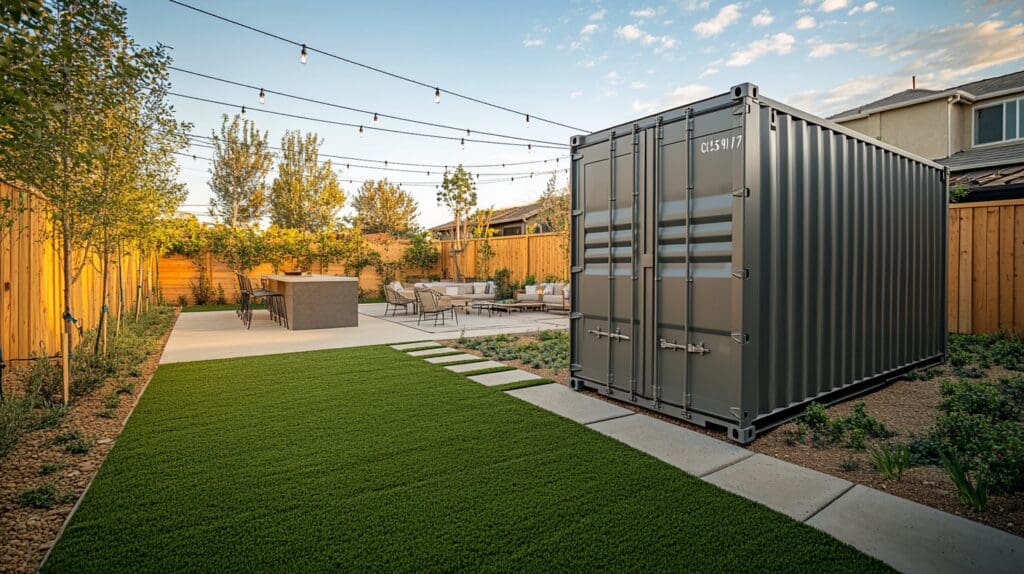
Something interesting is happening in backyards across the country. Homeowners are spending more money than ever turning their outdoor spaces into fully functional living areas—outdoor kitchens with built-in refrigerators, covered lounge zones with sectional sofas and fire pits, yoga decks, plunge pools, and entertainment setups that rival what’s inside the house. According to Brookfield Residential’s 2026 outdoor living trends report, the boundary between indoor and outdoor spaces is disappearing entirely, with seamless glass walls, continuous flooring, and dedicated outdoor rooms becoming standard features in new construction and renovation projects alike.
All of that is great for quality of life. But it creates a practical problem that nobody talks about until they’re standing in their yard with a tape measure and a frustrated expression: where does everything go?
The lawnmower, the leaf blower, the holiday decorations, the patio cushion sets you swap out seasonally, the kids’ bikes, the camping gear, the power washer. All of that stuff used to live in a shed tucked behind the garage or along the back fence. But now that corner has a pergola over a dining table, and the fence line has raised garden beds and string lights. The shed either doesn’t fit anymore or it would wreck the aesthetic that the homeowner just spent thousands of dollars to create.
That’s why a growing number of homeowners are skipping the shed entirely and buying steel shipping containers instead.
The 2026 Backyard Is a Living Room, Not a Storage Room
The outdoor living movement didn’t start in 2026, but it has reached an inflection point. Industry data shows that the global outdoor furniture market was valued at over $21 billion in 2023, and the U.S. outdoor living market is projected to reach $11.3 billion by 2027. Roughly 82 percent of American homeowners say they’re more interested in updating their outdoor spaces than they were before 2020, and 62 percent of millennials now prioritize outdoor entertaining spaces when shopping for a home.
What does that look like on the ground? Grilling stations are being replaced by full outdoor kitchens with prep counters, pizza ovens, and pass-through windows connecting to the interior kitchen. Basic patios are being upgraded into multi-zone layouts with separate areas for cooking, dining, lounging, and wellness. Homeowners are adding vertical gardens, water features, meditation corners, and covered outdoor living rooms complete with rugs, throws, and layered lighting.
Every one of those features eats square footage. A traditional 10′ × 12′ shed—the kind most homeowners default to—occupies 120 square feet of yard space. That’s roughly the same footprint as a four-person outdoor dining area with a built-in grill island. When you’re choosing between a shed and a feature that transforms how your family actually uses the yard, the shed loses every time.
The Storage Problem Hasn’t Gone Away—It’s Gotten Worse
Here’s the other side of the equation. While backyards are being converted into lifestyle spaces, the amount of stuff homeowners need to store is increasing, not decreasing. The outdoor storage shed market is valued at roughly $8.8 billion in 2026 and growing at over 5 percent annually, driven by rising homeownership rates, the DIY renovation boom, and the sheer volume of gear that modern households accumulate.
According to StorageCafe’s 2026 self-storage industry report, one in three Americans currently rents a self-storage unit, with an additional 18 percent planning to rent one in the near future. The average 10′ × 10′ non-climate-controlled storage unit now runs about $119 per month nationwide. In the Northeast—where Giant Lock Box serves customers across New York, New Jersey, Connecticut, Pennsylvania, Rhode Island, Ohio, and Texas—rates tend to run higher, especially in metro areas where demand outpaces supply.
That’s $1,428 a year. Over five years, a homeowner renting off-site storage will spend over $7,000—and they’ll still own nothing at the end of it. No equity. No asset. Just a monthly bill and a 20-minute drive every time they need their pressure washer.
Why a Shipping Container Solves Both Problems at Once
A 20-foot shipping container holds approximately 1,169 cubic feet of internal volume—more than most 10′ × 12′ sheds, and roughly equivalent to a 10′ × 20′ self-storage unit. But it occupies a footprint of just 8 feet wide by 20 feet long. That’s narrow enough to slide along a side yard, tuck against a fence line, or sit in a driveway without blocking vehicle access.
For homeowners who need even more capacity, a 40-foot steel storage container doubles the volume while maintaining the same 8-foot width. And if ceiling height matters—for storing tall items like ladders, kayaks, or shelving systems—a 20-foot high-cube container adds an extra foot of interior height over the standard unit.
Compare that to a backyard shed. Most residential sheds are built from wood or resin panels. They require a level foundation, often need a building permit depending on your municipality, and they deteriorate over time. Wood sheds are vulnerable to rot, termites, and moisture damage. Resin sheds can crack in extreme cold and warp in sustained heat. Neither material comes close to the structural integrity of 14-gauge corrugated Corten steel, which is what shipping containers are built from.
A steel shipping container is weatherproof, windproof, fireproof, and rodent-proof. It’s designed to survive trans-oceanic voyages stacked eight high on a cargo ship in open seas. Sitting in your side yard, it’s essentially indestructible.
Four Homeowner Scenarios Where Containers Beat Sheds and Storage Units
The shift from sheds to containers isn’t hypothetical. Here are four situations that are driving the trend right now.
1. The Renovation Stager
You’re remodeling a kitchen, redoing a bathroom, or finishing a basement. Furniture, appliances, and boxes need to go somewhere for weeks or months. Renting a PODS-style portable unit means ongoing monthly fees and someone else’s schedule for pickup and delivery. Renting a self-storage unit means loading a truck, driving across town, unloading, and repeating the whole process in reverse when the renovation is done.
A shipping container delivered by Giant Lock Box’s tilt-bed delivery truck gets placed where the truck can safely reach—in the driveway, along the side of the house, or in the backyard—and you load it at your own pace. When the renovation is done, you either keep it as permanent storage or have it picked up. No truck rental. No repeated trips. No fuel costs.
2. The Outdoor Gear Overflower
Kayaks, paddleboards, camping gear, fishing equipment, ski and snowboard setups, mountain bikes, golf clubs. Active families accumulate outdoor recreation gear fast, and garages fill up even faster. The typical two-car garage in the U.S. is about 400 square feet, and surveys consistently show that nearly a quarter of American homeowners can’t even park a car in their garage because it’s packed with stored items.
A 20-foot container along the side yard gives that gear a dedicated, secure, dry home without touching the garage or the backyard living space. The security features of a shipping container—heavy-duty lock boxes, reinforced doors, and steel walls—mean your $3,000 kayak and your kids’ bikes are protected from both weather and theft.
3. The Hobby and Workshop Builder
Woodworking benches, welding setups, auto restoration parts, gardening supplies, pottery kilns—hobbies generate materials and equipment that need more than a corner of the garage. Many homeowners dream of a dedicated workshop but don’t have the budget or the yard space for a standalone structure.
Shipping containers can function as both storage and workspace. With basic modifications, a container becomes a ventilated, lockable, weather-resistant workshop with enough room for a full workbench and tool wall. Giant Lock Box offers insulated containers for homeowners who want to moderate interior temperatures, and open-sided containers for those who need wide-access loading for large materials or equipment.
4. The Emergency Preparedness Planner
Severe weather events are becoming more frequent and more intense. According to the National Weather Service, every household should maintain a readily accessible emergency supply kit that includes water, non-perishable food, first aid supplies, batteries, flashlights, and important documents. The challenge is finding somewhere to keep all of that without cluttering up the house or garage.
A shipping container gives emergency supplies their own secure, climate-stable, rodent-proof space on your property. Unlike a shed, it won’t blow apart in high winds or let moisture seep in and destroy stored food or documents. And unlike an off-site storage unit, it’s in your yard—accessible 24/7 without driving anywhere during a storm or power outage.
The Long-Term Cost Math Favors Buying
Let’s put real numbers on the comparison. A standard 10′ × 20′ self-storage unit—roughly the same capacity as a 20-foot shipping container—averages $200 to $300 per month in the Northeast. Over three years, that’s $7,200 to $10,800 in rent with nothing to show for it. Over five years, the total climbs to $12,000 to $18,000. And that’s before factoring in the cost of a moving truck, fuel, insurance surcharges, and the time spent driving back and forth.
A quality used 20-foot shipping container, purchased outright, can pay for itself within one to two years compared to ongoing storage rental fees. After that, every month is free storage. The container sits on your property, you have the key, and you access it whenever you need to—no facility hours, no gate codes, no monthly invoices.
For homeowners weighing the cost of a backyard shed, the math is equally compelling. A mid-range wood shed in the 10′ × 12′ range typically runs $3,000 to $6,000 installed, and it will need maintenance—repainting, re-roofing, treating for rot or pests—within five to seven years. A shipping container requires virtually zero maintenance over the same period and offers dramatically better protection against weather, fire, and break-in attempts.
Delivery and Placement: Containers Go Where Sheds Can’t
One of the biggest concerns homeowners have about shipping containers is whether they can actually be placed without destroying the yard or blocking the new patio. This is where Giant Lock Box’s delivery system changes the conversation.
Container delivery uses tilt-bed trucks that need a reasonably straight, level approach to back in and slide the container off the bed. The container ends up where the truck can safely reach—so the access route and the placement spot matter. Curved driveways, slopes, and narrow side yards all affect what’s possible, which is exactly why the planning happens before delivery day, not on it.
Giant Lock Box uses a tilt-bed delivery truck built for containers and walks your site first so we place the unit precisely where the truck can safely reach—the driveway, the side of the house, or the spot you’ve planned in the backyard. If a site is too tight or too steep to do it right, we tell you before you pay. Each container is leveled on blocks to protect the property surface, provide airflow underneath, and prevent animals from nesting beneath it.
That precision placement is what makes containers work alongside outdoor living upgrades rather than against them. The container tucks into the narrow side yard while the backyard stays open for the outdoor kitchen, the fire pit lounge, and the kids’ play area.
Steel Beats Wood and Resin in Every Category That Matters
When homeowners compare storage options side by side, the advantages of steel shipping containers become hard to ignore.
Security. A shipping container’s 14-gauge corrugated steel walls and heavy-duty lock box are engineered to resist forced entry. A wood or resin shed can be breached with a basic pry bar in under a minute. For homeowners storing power tools, recreation equipment, or valuables, the difference in protection is enormous.
Weather resistance. Shipping containers are designed to keep cargo dry through weeks at sea in storms, salt spray, and temperature swings. A residential shed is designed to keep rain off garden tools in a suburban backyard. They’re not in the same category.
Longevity. A well-built wood shed lasts 15 to 20 years with regular maintenance. A shipping container’s steel structure lasts 25 years or more with essentially no maintenance. The container you buy today is likely the last storage solution you’ll ever need for that property.
Portability. If you move, a shipping container can be picked up and delivered to your new address. A shed stays where it was built.
Resale value. Used shipping containers hold their value well because the steel itself retains worth. A used shed has little to no resale value.
Choosing the Right Container for Your Home
Not every homeowner needs the same setup, and choosing the right size matters. Here’s a quick guide based on typical residential use cases.
For seasonal storage, holiday decorations, lawn equipment, and patio furniture rotation, a standard 20-foot container provides more than enough capacity for most households. It holds roughly the equivalent of a one-bedroom apartment’s worth of furniture and boxes.
For families with large recreation gear collections, home renovation staging, or combined storage and workshop needs, a 40-foot container doubles the usable space without adding width. Some homeowners partition a 40-footer into separate zones—half for storage, half for a workspace.
For items sensitive to temperature swings—electronics, documents, paint, upholstered furniture—an insulated container moderates interior conditions and reduces condensation risk.
And for homeowners who need to load and unload bulky items like riding mowers, ATVs, or large workshop equipment, a double-door container provides access from both ends, making it far easier to organize and retrieve items without moving everything in front of them.
Giant Lock Box: Storage That Works With Your Backyard, Not Against It
Giant Lock Box has been delivering shipping containers to homeowners, contractors, and businesses across the Northeast and Texas for years. We understand that buying a container for your property is different from buying one for a construction site. Homeowners want precise placement, minimal disruption, and a storage solution that doesn’t undo the work they’ve put into their outdoor spaces.
That’s why we deliver every container with a tilt-bed truck built for containers and plan the placement with you first—so it goes where the truck can safely reach. We level it on blocks to protect your surface and provide airflow. We sell new and used containers in every standard size, along with specialty options for homeowners who need insulation, side access, open tops, or refrigeration.
We serve homeowners in New York, New Jersey, Connecticut, Pennsylvania, Ohio, Rhode Island, and Texas. If your backyard is getting full and your storage needs are growing, request a quote today or call us at (845) 343-0700. We’ll help you find the right container, deliver it where it needs to go, and give your stuff a permanent home that doesn’t cost you a single square foot of outdoor living space.