
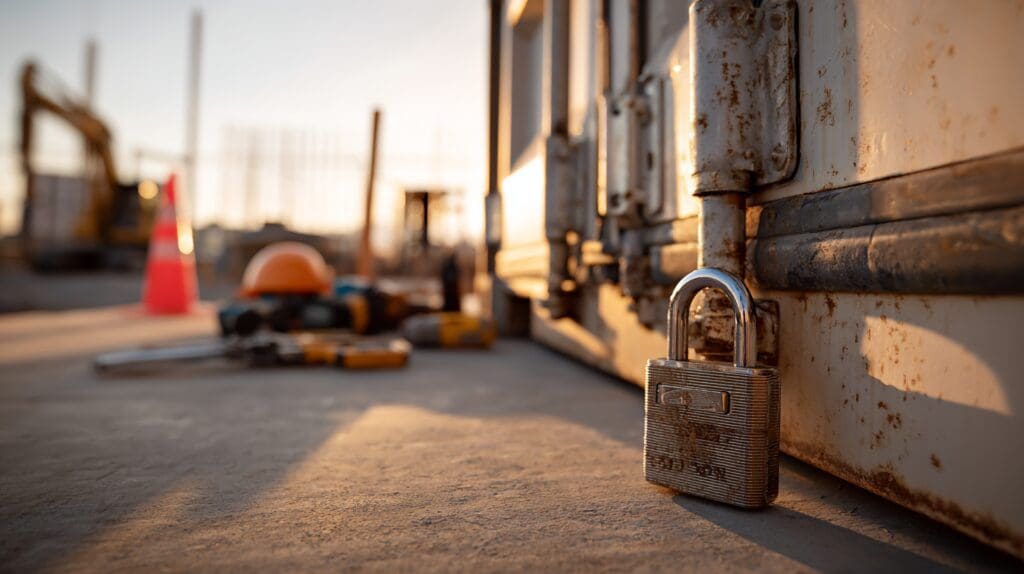
Here’s a scenario that plays out more often than most contractors want to admit: a crew shows up Monday morning and finds the lock cut off their jobsite storage container. Power tools, cordless battery sets, a laser level, and a generator—all gone. The project manager calls the insurance company expecting a straightforward claim. Instead, the adjuster starts asking questions nobody prepared for: “Was the container classified as a building on your policy?” “Were those employee-owned tools or company-owned?” “Does your coverage extend to temporary storage locations?
Suddenly, a theft loss that should have been a clean claim turns into weeks of back-and-forth over policy language nobody read closely enough.
If you’re storing tools, equipment, or materials in a shipping container—whether it’s parked on a jobsite, in a driveway, or behind a warehouse—the insurance question is worth getting right before something goes missing. Construction site theft costs the industry over $1 billion every year, and only about 25% of stolen equipment is ever recovered.1 Those numbers get even harder to swallow when your insurer disputes the claim.
The 2026 Problem: More Gear in Temporary Storage, Tighter Policy Language
A few things have converged to make this an especially pressing issue right now. Material costs keep climbing, which means contractors are buying higher-quality tools that cost more to replace. Jobsites are running leaner with tighter schedules, so equipment stays on location longer instead of cycling back to a shop or warehouse every night. And insurers, facing their own pressure from rising claim costs, have been quietly tightening the language around where and how stored items are covered.2
Shipping containers have become one of the most popular solutions for jobsite storage precisely because they’re tough to break into. Fourteen-gauge corrugated steel walls, heavy-duty lockboxes, and weathertight seals make them far more secure than a plywood tool shed or an open trailer with a tarp. But here’s the catch: your insurance policy doesn’t care how strong the box is if the policy doesn’t recognize the container as a covered location in the first place.
Is a Shipping Container a “Building”? It Depends Who You Ask
This is the question that trips up more claims than you’d expect. A recent case study published in IA Magazine—a leading insurance-agent trade publication—walked through a real-world scenario where tools were stolen from a locked Conex box on an active jobsite. The central dispute came down to whether the container qualified as a “building” under the contractor’s commercial property policy.3
Most standard commercial property forms define a building as a permanent structure at a described premises. A shipping container sitting on a construction site doesn’t always check those boxes. It’s temporary. It’s mobile. It might not even be listed on the policy as a scheduled location. That ambiguity creates a gap that can leave your tools and equipment uninsured—even though you took reasonable steps to lock them up in a steel box.
Employee-owned tools add another layer of complexity. If your electricians and plumbers bring their own tools to the jobsite and store them in the company’s container overnight, those personal tools may not fall under your commercial property coverage at all. Some policies treat employee tools as a separate category that requires its own endorsement. Others have sub-limits so low they barely cover a single cordless drill set.
Three Policies Every Contractor Should Review Before the Next Delivery
If you’re using shipping containers for jobsite storage—or planning to—here are the three coverage areas to sit down and discuss with your insurance agent.
1. Commercial Property Endorsements
Your commercial property policy is where tools and equipment coverage usually starts. The key questions to ask: Does this policy cover property at locations other than my primary business address? Is a shipping container recognized as a covered structure, or does it fall into a gray area between “building” and “unscheduled property”? Are employee-owned tools covered when stored in my container, and if so, up to what limit?
Many contractors discover after a loss that their policy only covers tools “used in your business” when they’re stored “in your building”—and a jobsite shipping container may not meet either definition without an explicit endorsement.3 The fix is usually straightforward. Your agent can add a scheduled location or adjust the policy to recognize temporary jobsite storage. But it has to be done before the claim.
2. Inland Marine / Contractor’s Equipment Coverage
Inland marine insurance is the workhorse policy for contractors who move equipment between locations. Unlike commercial property, which is designed for fixed premises, inland marine is specifically built to cover tools, machinery, and materials in transit or at temporary worksites.2
The catch? Not all inland marine policies are written the same way. Some cover equipment at any jobsite automatically. Others require you to report each new location. And the language around “temporary jobsite storage”—including locked shipping containers, trailers, and gang boxes—varies enough from carrier to carrier that assumptions will burn you. Ask your agent specifically whether items stored inside a locked shipping container at a jobsite are covered, and whether there’s a per-location or per-item limit you should know about.
3. Builders Risk Provisions
If you’re working on new construction or a major renovation, there’s often a builders risk policy in play. Builders risk is meant to cover materials, fixtures, and equipment that are part of—or will become part of—the structure being built. Some policies extend that coverage to stored materials and equipment at or near the jobsite.
Here’s where a shipping container matters: if your builders risk policy covers materials stored “at the project site,” a container on-site should qualify. But if the container is parked across the street, in a staging lot down the road, or on an adjacent property, you may have a coverage gap. And if the container itself is rented rather than owned, some policies may treat the contents differently. Updated 2026 contractor insurance guides stress that stored-material clauses need explicit attention for off-site and temporary storage locations, including containers.
Why the Container You Choose Matters for Insurability
Insurance underwriters think in terms of risk. The harder you make it for a thief to access your tools, the lower your risk profile—and the easier it is to get favorable coverage terms. This is one area where shipping containers have a clear security advantage over almost every other form of portable storage.
A standard shipping container is built from 14-gauge corrugated Corten steel designed to survive ocean crossings. The doors are fitted with heavy-duty cam bars and can accept high-security lockboxes that resist bolt cutters and pry bars. Compare that to a plywood shed, a canvas-sided trailer, or a plastic storage unit from a big-box store, and the difference in forced-entry resistance isn’t even close.
When you pair that physical security with documented inventory practices and correctly written insurance endorsements, you’re building what risk managers call a “security stack”: hardened storage plus procedural controls plus financial protection. Each layer reinforces the others. An insurer is far more likely to write favorable terms when they see that you’re taking physical security seriously—and a locked steel container is a strong signal.1
A Quick Word for Homeowners
This isn’t just a contractor issue. If you’re a homeowner who’s added a shipping container to your property for workshop storage, renovation overflow, or backyard organization, your homeowners insurance may handle it differently than you expect.
Homeowners policies typically cover tools and personal property stored in “other structures” on your property—think detached garages, sheds, and barns. But whether a shipping container qualifies as an “other structure” or gets treated as temporary personal property can vary by carrier. Some policies have lower coverage limits for detached structures, and a container full of power tools, lawn equipment, or hobby gear could easily exceed that sub-limit.
With 2026 trends showing more homeowners investing in outdoor living spaces, workshop setups, and renovation projects, the amount of valuable gear stored outside the main house keeps growing. If you’re planning to drop a 20-foot container in your driveway or backyard, a five-minute call to your agent could save you a five-figure headache later.
Questions to Ask Your Insurance Agent Before You Move Tools into a Shipping Container
Print this list, email it to your agent, or bring it to your next policy review. Each question maps to a real coverage gap that has cost contractors and homeowners real money.
- ☐ Does my policy cover tools and equipment stored at temporary jobsite locations, or only at my primary business address?
- ☐ Is a shipping container recognized as a “building” or “covered structure” under my policy, or do I need an endorsement?
- ☐ Are employee-owned tools covered when stored in a company container on-site? What’s the sub-limit?
- ☐ Does my inland marine policy automatically cover new jobsite locations, or do I need to report each one?
- ☐ Is there a per-item or per-location limit I should know about for equipment stored in a container?
- ☐ Does my builders risk coverage extend to materials and tools stored in a container at or near the project site?
- ☐ If the container is rented rather than owned, does that change how my policy treats the contents?
- ☐ For homeowners: Does my homeowners policy treat a shipping container as an “other structure,” and what’s the coverage limit for contents?
Start With the Right Box
No insurance endorsement can protect tools that are easy to steal. The foundation of any jobsite or property storage strategy is physical security—and that starts with the container itself.
At Giant Lock Box, we sell and rent heavy-duty steel shipping containers in 20′ and 40′ sizes, delivered directly to your site by our tilt-bed delivery truck and placed precisely where the truck can safely reach. Every container is built to withstand weather, forced entry, and years of hard use. Whether you’re storing tools on an active construction site, staging materials for a renovation, or setting up long-term storage on your property, the right container gives you a secure foundation that makes everything else—locks, inventory management, insurance coverage—work better.
Call us at (845) 343-0700 or request a quote online to find the right size and configuration for your project. We serve Connecticut, New Jersey, New York, Ohio, Pennsylvania, Rhode Island, and Texas.
Sources
- KamGard. “How Construction Managers Are Losing $1B+ to Jobsite Theft—And How to Stop It.” February 14, 2026. https://kamgard.com/blog/construction-jobsite-theft-prevention/
- Grit Insurance Group. “Inland Marine Insurance for Contractors: What It Covers, Why It Matters, and How Contractor Equipment Insurance Protects Your Business.” https://gritinsurance.com/blog/inland-marine-insurance-for-contractors-what-it-covers-why-it-matters-and-how-contractor-equipment-insurance-protects-your-business
- IA Magazine (Independent Agent). “Commercial Property Coverage for Tools Stolen from Jobsite.” January 23, 2026. https://www.iamagazine.com/2026/01/23/commercial-property-coverage-for-tools-stolen-from-jobsite/
Disclaimer: This article is for informational purposes only and does not constitute insurance or legal advice. Coverage terms vary by carrier, policy, and state. Always consult a licensed insurance agent or broker to review your specific policy language before making coverage decisions.