
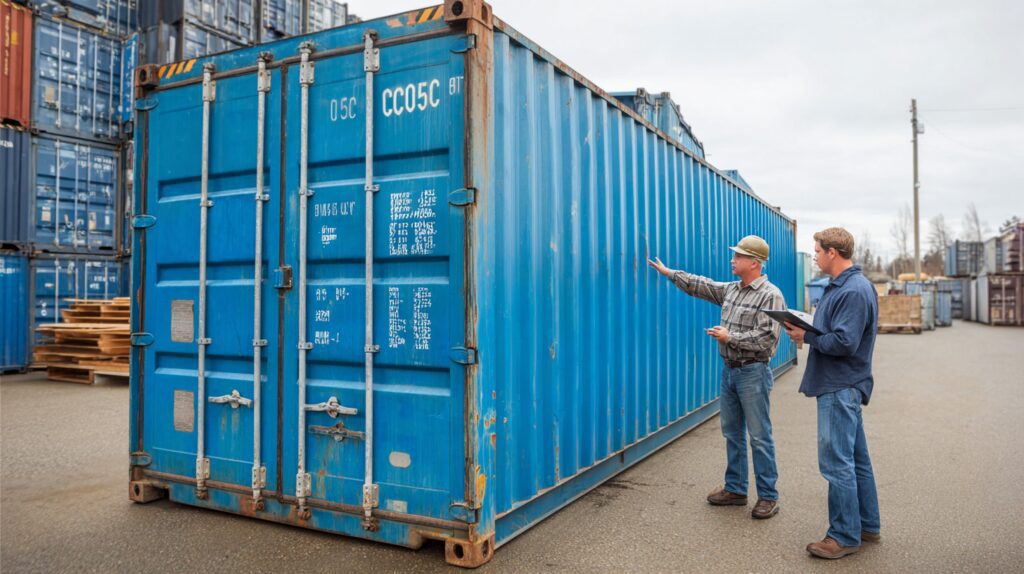
Buying a shipping container is one of the simplest large purchases you can make—once you understand the four decisions that determine whether you get a great deal or an expensive headache. Size. Condition grade. Supplier legitimacy. Delivery logistics. Get these right, and you’ll own a steel box that stores your belongings for decades. Get them wrong, and you’ll learn why this market has a reputation for surprising first-time buyers.
This guide walks through the complete purchasing process from start to finish, using current 2026 pricing and the hard-won lessons of buyers who came before you.
Step 1: Match the Container Size to the Job
The first decision—size—drives every cost that follows. A container that’s too small means double the delivery and site prep when you inevitably need a second unit. A container that’s too large wastes money on capacity you’ll never use and may create unnecessary permitting issues on tighter residential lots.
More than 80% of containers sold in North America fall into three standard sizes. Sticking to these keeps your options wide, your pricing competitive, and your sourcing straightforward.
20-foot standard containers offer roughly 160 square feet of floor space and about 1,169 cubic feet of volume. This is the most popular size for homeowners who need overflow storage—clearing out a garage for a renovation, holding seasonal gear, or creating a secure tool lockup. For help figuring out what actually fits, check out our breakdown of how much furniture can fit in a 20-foot container.
40-foot standard containers double the capacity to about 320 square feet. Contractors use these for jobsite material storage, and homeowners clearing an entire basement or two-car garage will find the extra length essential. Our guide to how much furniture can fit in a 40-foot container gives you a practical sense of what 40 feet can hold.
40-foot high-cube containers add an extra foot of interior height (9’6″ vs. the standard 8’6″). If you’re converting a container into a workshop, office, or on-site work hub, the high-cube is the only practical choice—drywall, insulation, and subflooring eat into vertical clearance fast, and a standard container will leave you with barely 7 feet of headroom.
Beyond these three workhorse sizes, Giant Lock Box also offers specialty containers including double-door (tunnel) units that open from both ends, open-sided containers for bulky equipment, open-top containers, and refrigerated containers for temperature-sensitive goods. Specialty units cost more and take longer to source, but they solve problems that standard dry containers can’t.
If you’re not sure which size fits your situation, our guide on choosing the right size in shipping containers walks through the decision in detail.
Step 2: Understand Condition Grades Before You Compare Prices
Condition—not just size—is the single biggest price driver in the container market. And here’s the part most buyers miss: there is no universal grading standard. The same container could be labeled “Wind and Water Tight” by one seller and “Cargo Worthy” by another. What matters is the written description on the invoice, not the label.
Here’s what each grade actually means:
New / One-Trip. These containers were manufactured overseas (roughly 85% come from China), loaded with cargo for a single voyage to the U.S., and then sold domestically. They’re in near-new condition—minor scratches and handling marks are normal, but structurally and cosmetically they’re the best you can buy. One-trip units are the right choice for conversions, customer-facing applications, and buyers who want maximum lifespan.
Cargo Worthy (CW). A CW container has passed a third-party structural inspection and carries a current CSC plate. According to the International Maritime Organization’s Convention for Safe Containers, the CSC plate confirms the unit meets international safety standards for stacking and intermodal transport. CW is the grade you need if you plan to ship the container overseas—but for domestic storage, you’re paying for certification you may never use.
Wind and Water Tight (WWT). The most popular grade for domestic storage buyers. A WWT container has been retired from freight service but keeps wind and rain out. It may have surface rust, dents, repaired panels, and cosmetic wear. There’s no CSC plate, so it can’t be exported—but for on-site storage at a home or jobsite, it’s the sweet spot between price and performance.
As-Is. Sold with visible damage, significant corrosion, or no condition guarantee whatsoever. These are the cheapest containers on the market—and the riskiest. An as-is container may have rust holes, warped doors, broken floor planks, or structural damage that makes it unsuitable for anything beyond scrap. Our guide on evaluating a shipping container’s condition before buying covers exactly what to look for so you don’t get stuck with a lemon.
Step 3: Budget for the Real Total Cost
The sticker price of a container is rarely the full cost. Delivery, site preparation, hardware, and taxes can add 30% to 50% above the unit price—a surprise that catches most first-time buyers off guard. According to Angi’s 2026 cost data, delivery fees alone average around $3,000 nationally, and site preparation can add several hundred to several thousand more depending on your property.
2026 Container Price Ranges
Current market pricing for standard containers in the U.S.:
A used 20-foot container in WWT or CW condition typically runs $1,150 to $4,000. A new one-trip 20-foot runs $2,100 to $6,000. Used 40-foot containers run $1,475 to $6,500, while new one-trip 40-foot units run $4,200 to $9,000. A new 40-foot high-cube runs $2,900 to $6,500, and new refrigerated containers run $8,000 to $12,000.
Prices vary significantly by depot region, inventory levels, and season. Always get quotes from at least three suppliers within your delivery radius.
Additional Costs to Plan For
Delivery: $300 to $2,500+ depending on distance. Buyers near major ports pay less; inland and rural locations pay more. Booking during off-peak windows (February through March or September through October) can reduce transport costs by 10% to 25%.
Site preparation: Gravel pad, concrete slab, or at minimum railroad ties or concrete blocks under the four corners. This prevents rust, settling, and door misalignment.
Permits: Varies by municipality, typically $15 to $500. Check before you order.
Hardware and modifications: Lock boxes, padlocks, vents, roll-up doors, shelving, electrical, insulation—whatever your application requires beyond a bare steel box.
Sales tax: 6% to 10% depending on your state. Often excluded from advertised prices.
For a detailed breakdown of where these costs hide, see our companion piece on the hidden costs of buying a shipping container in 2026. And if you’re a contractor or small business owner, the 2025–2026 Section 179 tax rules may let you write off the full purchase price in the year you buy.
Step 4: Vet the Supplier Before You Pay
The container market attracts scammers because buyers often can’t see the unit before purchase, depot yards aren’t open to the general public, and payment happens before delivery. Legitimate suppliers are either direct sellers (they own their inventory) or brokers (they resell from multiple depots). Neither model is inherently bad, but transparency varies widely.
Red Flags That Should Stop You Cold
Below-market pricing. If a container is listed at half the going rate, it’s almost certainly a bait-and-switch—either the unit doesn’t exist, the grade will be far worse than described, or the fees will multiply after you commit.
Irreversible payment methods. The Federal Trade Commission warns that wiring money is like sending cash—once it’s gone, you probably won’t get it back. If a seller demands payment via wire transfer, Zelle, Venmo, Cash App, cryptocurrency, or gift cards, walk away. These are the payment methods scammers prefer precisely because they can’t be reversed.
No verifiable business identity. A brand-new website with no physical address, no reviews, and no phone number a human answers is a red flag. So is a seller who refuses in-person inspection or can’t provide unit-specific photos and video.
Stock photos. If the same container photo appears on multiple listings across different websites, verify it with a reverse image search. Scammers reuse images because they don’t have actual inventory.
Brand impersonation. Legitimate companies—including Giant Lock Box—have been impersonated in fake ads and listings. If a deal seems too good to be true, verify directly by calling the company’s main phone number (for us, that’s (845) 343-0700).
How to Verify a Seller
Confirm the business registration, physical address, and phone number independently. Ask to visit the yard or request a walk-around video of the exact unit you’ll receive. For remote purchases, prioritize suppliers who offer pay-on-delivery or inspection-on-arrival terms. And whenever possible, pay by credit card—it’s the only payment method that gives you meaningful chargeback protection.
Step 5: Inspect Before You Accept
Whether you’re inspecting in person at a depot or on delivery day, work through these seven areas in order of structural importance:
1. Structural frame. Check corner posts, top and bottom rails, and corner castings (the lifting points). Structural frame damage is expensive to repair and compromises everything else. Cosmetic dents on the frame don’t matter—cracks and bends do.
2. Exterior walls. Look for the severity and location of rust. Surface oxidation is normal on used containers; pitting or through-wall corrosion is a problem. Check for poorly done patch repairs—a plate welded over a hole is only as good as the welds.
3. Roof. Press on any depressions. Roof dents that pool water accelerate corrosion from the inside out. Check seam condition where the roof panels meet the rails.
4. Floor. Step on every section. Soft spots, broken planks, and bounce indicate deterioration underneath. This is also the time to do a smell test—some used containers carry residual fumigant or pesticide odors from prior cargo, and this is an issue buyers frequently overlook.
5. Doors. Open and close both doors fully. Test seals, hinges, lockrods, and alignment. If the doors don’t swing smoothly and seal tightly, the container likely isn’t level—or the frame has shifted.
6. Interior. Close the doors from inside and look for pinholes of daylight coming through the walls or roof. Check for water staining, evidence of pests, and odor.
7. CSC data plate. If you’re buying a CW-graded container, verify the CSC plate is present on the left door, check the manufacturing date, and confirm the container number on the plate matches the number stenciled on the exterior.
For a complete walkthrough, see our detailed guide on what to look for when buying a shipping container.
Step 6: Plan Delivery and Site Access
Getting delivery logistics wrong is the most common last-minute problem in this market. Delivery method drives your site requirements, so it’s worth understanding before the truck shows up:
Tilt-bed delivery truck is the standard for residential delivery. The trailer tilts and the container slides off via winch as the truck pulls forward. This requires 100 to 125 feet of straight-line clearance and at least 18 feet of vertical clearance under wires and branches. The container lands in line behind the truck, on firm, accessible ground.
Flatbed plus on-site lifting equipment is another option some suppliers use: the container is lifted off the trailer so the truck can leave in any direction. You’ll need roughly 60 feet of clearance and lifting equipment on site—which you’ll need to rent if you don’t own it.
Giant Lock Box delivers with a tilt-bed delivery truck as standard. Precise placement is included in the delivery—not an add-on fee. We walk your site first and set the container exactly where the truck can safely reach, which eliminates the dry-run risk, the site-access surcharge, and the frustration of finding out at the last minute that the access won’t work.
Pre-Delivery Checklist
Before the truck arrives, make sure you’ve handled these items:
- Prepare a level pad (gravel, concrete, or railroad ties at the four corners) to prevent rust, settling, and door misalignment
- Decide door orientation before the truck loads—the container is positioned on the trailer accordingly
- Clear overhead lines, branches, and side obstructions along the truck’s approach path
- Confirm driveway width (minimum 10 feet for most trucks) and load capacity
- Check local permit requirements before the unit is placed
Step 7: Close the Purchase and Sign for Delivery
Before sending final payment, confirm the invoice includes the container number (if available), exact size and condition grade, price and payment terms, delivery date, delivery address, door orientation, and the return or refund policy for condition discrepancies.
On delivery day, inspect the unit against the described grade before the driver leaves. Photograph any damage immediately. Note discrepancies on the delivery paperwork before you release final payment, if your terms allow it.
Once the container is placed and you’ve confirmed the doors open and close properly, add security hardware (lock box and puck lock at minimum), check that leveling is correct, and consider moisture management if you’re storing furniture, electronics, or other humidity-sensitive items.
10 Questions to Ask Any Seller Before You Buy
- Can I pick the container out in person, or get photos and video of the exact unit I’ll receive?
- What condition grade is this unit, and who graded it?
- Is there a current CSC plate, and what’s the manufacturing date?
- What type of flooring does it have (marine plywood, bamboo)?
- Are you the direct supplier or a broker?
- What’s included in the delivery quote—mileage, fuel, wait time?
- What delivery method will be used, and what site access is required?
- What’s the return or refund policy if the unit doesn’t match the described grade?
- What payment methods do you accept?
- How long has your business been operating, and can you provide references?
For more on negotiating the best terms once you’ve found a legitimate seller, see our guide on mastering the art of negotiating prices for shipping containers.
The Decision Path
Use case → Size → Grade → Budget (unit + delivery + prep) → Vetted supplier → Inspection → Delivery logistics → Documented close.
Sticking to standard sizes (20-foot, 40-foot, or 40-foot high-cube), matching grade to use (WWT for storage, CW for export, one-trip for conversions), insisting on inspection or pay-on-delivery terms, and preparing your site for the right delivery method eliminates the vast majority of buyer-side risk in this market.
Giant Lock Box carries new and used shipping containers for sale across New York, New Jersey, Connecticut, Pennsylvania, Ohio, Rhode Island, and Texas, with transparent pricing, tilt-bed delivery, and the kind of honest guidance that makes first-time buyers feel like repeat customers.
Ready to buy with confidence? Request a quote or call (845) 343-0700 to talk through your project.