
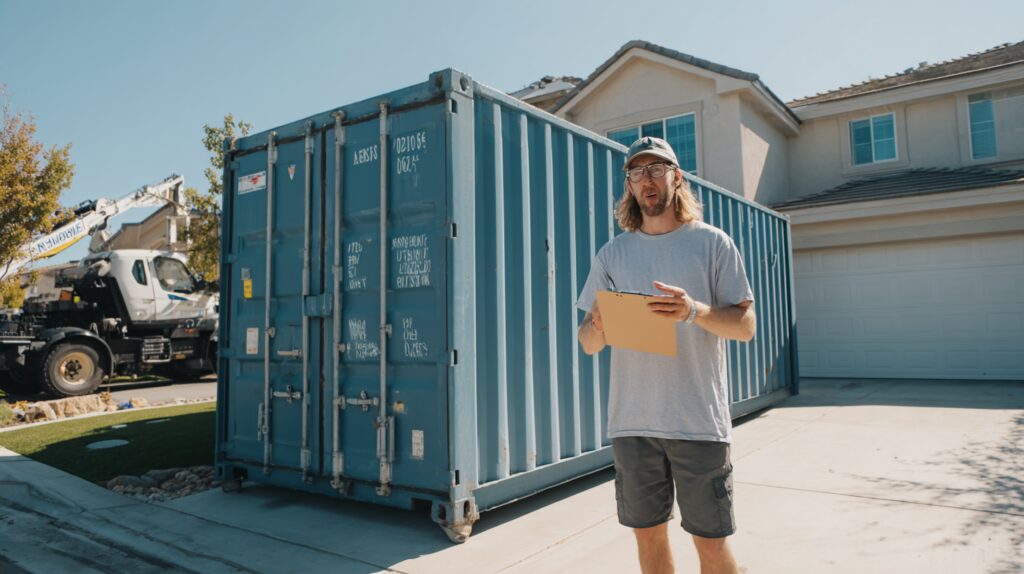
You’ve found a used 20-foot shipping container online for $1,800. Seems like a steal, right?
Then the delivery quote comes in. And the site prep estimate. And the lock box upgrade. And the sales tax. And by the time the container is actually sitting on your property, you’ve spent $4,500 instead of $1,800—and you’re wondering how the “real” price ended up nearly triple the listing.
This is the most common buying experience in the shipping container market, and it happens to homeowners and contractors alike. The container itself is rarely the biggest line item. The real cost lives in everything that surrounds it: delivery, site preparation, hardware, taxes, permits, and the surprise fees that don’t show up until after you’ve signed.
This guide breaks down every hidden cost you should expect when buying a shipping container in 2026—and how to avoid paying more than you should.
The Container Itself Is Usually the Smallest Number
Let’s start with what you’re actually buying. According to current 2026 market data from Metal Buildings, used 20-foot containers run $1,200 to $2,800, used 40-foot containers run $1,800 to $3,500, and new “one-trip” units range from $2,500 for a 20-foot up to $7,000 for a 40-foot high-cube.
Those base prices look attractive on paper. But industry analysts consistently warn that delivery, drayage, and site prep typically add 30% to 50% above the unit price for most buyers. In some cases, the all-in cost ends up being two to three times the sticker price of the container itself.
Choosing the right container size from the start is the first decision that affects every downstream cost—too small and you’re paying twice for delivery and site prep on a second unit; too big and you’re paying for capacity you’ll never use. Here’s where that extra money actually goes.
Hidden Cost #1: Delivery
This is the biggest surprise for most first-time buyers. Delivery isn’t a flat fee—it scales with distance, access conditions, the type of truck required, and whether your site needs special equipment.
According to Angi’s 2026 cost data, delivery fees average around $3,000 nationally, though that number varies dramatically by location and access. Buyers near major port cities (Newark, Long Beach, Houston, Savannah) consistently pay less because containers are physically closer. Buyers in landlocked or rural areas pay more because trucks have to travel farther.
Typical delivery cost ranges in 2026:
- Local delivery (within 50 miles of a depot): $300 to $700
- Regional delivery (50 to 200 miles): $700 to $1,500
- Long-distance delivery (200+ miles): $800 to $2,500 or more
Beyond distance, delivery cost is also affected by site access. Tilt-bed delivery needs a reasonably straight, level approach with roughly 12 feet of width clearance and 16 feet of vertical clearance to back in and set the container down cleanly. If your property is tight—narrow driveway, low-hanging wires, slope, gate that doesn’t open wide enough—the site may need prep first, or a different placement spot, which can add to the cost. The point is to identify that before delivery day, not after.
This is where buyers often get stung. They accept a low online quote, only to be hit with a “site access surcharge” after the dispatcher reviews the property. Or worse, the truck shows up, can’t make the delivery, and the buyer pays a “dry run” fee of several hundred dollars before rescheduling with the right equipment.
How Giant Lock Box handles this differently: Our Shipping Container Delivery and Placement Guide walks through exactly how our tilt-bed delivery works. We review your site before we schedule—photos of the approach and the placement spot—so there are no surprise access upcharges and no dry run risk. If your site won’t work for the truck, we tell you before you pay. When it does, we place the container precisely on suitable, accessible ground right where you need it.
Hidden Cost #2: Site Preparation
A shipping container can’t just sit on your lawn. It needs a level, stable surface that won’t shift, sink, or trap moisture against the bottom rails. Skipping site prep saves money upfront and costs more later when doors stop closing properly and rust starts eating through the floor.
Common site preparation costs in 2026:
- Concrete blocks or railroad ties (basic leveling): $200 to $500
- Compacted gravel pad: $500 to $1,200
- Grading and drainage work: $300 to $1,500
- Full concrete slab foundation: $2,000 to $4,500
For most residential storage applications, a gravel pad or concrete blocks are perfectly adequate. For long-term placements or container conversions (offices, workshops), a more substantial foundation makes sense.
The hidden cost trap here is buyers who don’t budget for site prep at all and then discover after delivery that their container is sitting at an angle, the doors are binding, and water is pooling underneath. Fixing those problems retroactively costs significantly more than doing the prep correctly the first time.
How Giant Lock Box helps: Every Giant Lock Box delivery includes leveling blocks placed under each corner of the container during delivery. This protects your property, ensures proper door operation, and provides air circulation underneath—without an additional charge.
Hidden Cost #3: Permits, Sales Tax, and Local Fees
This is the cost category buyers most often overlook entirely.
Permits. Many municipalities require a permit for placing a shipping container on residential property, especially if it will be visible from the street, located in a front yard, or staying for an extended period. Permit costs typically range from $15 to $500 depending on your location, the placement, and the intended use. Rural and agricultural zones tend to have looser rules; urban and suburban areas tend to have stricter ones.
Sales tax. Depending on your state, sales tax on a shipping container purchase can add 6% to 10% to the total. On a $5,000 container, that’s $300 to $500 you might not have budgeted for.
HOA fees and inspections. If you live in a homeowner’s association, you may need to pay for an architectural review or approval before placement. Some HOAs charge a fee just to consider the request—and may deny it entirely if you didn’t ask first.
For homeowners and contractors in New York, the state and several municipalities have introduced specific 2025–2026 rules for shipping containers in New York that buyers should review before ordering. The same applies to buyers in New Jersey, Connecticut, Pennsylvania, Ohio, Rhode Island, and Texas—every state has its own quirks. Buyers in Trenton specifically should review our list of common mistakes to avoid when buying containers in Trenton, NJ for a regional perspective on what trips up first-time buyers.
Hidden Cost #4: Hardware, Security, and Add-Ons
The container itself is just a steel box. To make it secure, accessible, and functional, you’ll need a few additional items that often aren’t included in the base price.
Lock box. A factory-installed lock box that protects the door padlock from bolt cutters is standard on new one-trip containers but typically costs $75 to $200 to add to a used unit. Without it, your security is limited to whatever lock you can fit through the door handles—which determined thieves can defeat in seconds. For a deeper look at how containers protect contents, see our breakdown of security features of shipping containers.
High-security padlock. A quality puck lock or hardened steel padlock runs $40 to $150. Cheap padlocks are not a meaningful security investment.
Interior shelving. If you’re using the container for tool or material organization, basic shelving systems run $200 to $1,000+ depending on size and quality.
Vents. Adding passive vents to reduce condensation costs $100 to $300 installed. For most storage applications, this is optional but recommended in humid climates.
Insulation. If you need temperature stability for stored items, basic spray foam insulation can add $1,500 to $4,000 to a 20-foot container. For most storage uses, this isn’t necessary—but if you’re considering it, an insulated shipping container purchased that way from the start is more cost-effective than retrofitting later.
Hidden Cost #5: Buying the Wrong Size or Grade
This is the costliest mistake on the list because it’s the hardest to undo.
Buying too small. A homeowner orders a 20-foot container thinking it will hold the contents of their garage. After loading it, they realize they need a second container or have to leave items behind. Now they’re paying for a second delivery, a second permit (potentially), and a second site prep. The “savings” from going smaller evaporates immediately.
Buying too cheap. “As-is” containers are sold without inspection or warranty. They’re the cheapest option on the market, but they may have rust holes, warped door seals, broken floors, or structural damage that makes them unsuitable for anything except scrap. The savings disappears the first time it rains and your stored belongings get soaked. Our guide on key tips for evaluating a shipping container’s condition before buying walks through exactly what to inspect before signing.
Buying without understanding grades. Used shipping containers are graded by condition. “Wind and Water Tight” (WWT) units are weather-sealed and structurally sound. “Cargo Worthy” (CW) containers meet international shipping standards. “As-is” containers come with no guarantees. For storage applications, WWT is the sweet spot—affordable but reliable. Don’t pay CW prices for storage you’ll never ship, but don’t accept as-is grade either.
For most buyers, a 20-foot container handles single-garage overflow, while a 40-foot or 40-foot high-cube container is the right call for clearing an entire garage, finishing a basement, or contractor jobsite use. If you’re not sure where to even start sourcing units, our overview of where to buy shipping containers covers the major channels and their tradeoffs.
Hidden Cost #6: Multiple Moves and Repositioning
This one bites contractors hardest. You buy a container for a jobsite, the project ends, and now you need to move it to the next location. Or you place a container on your property, then realize six months later that it’s in the wrong spot and needs to be repositioned.
Repositioning a container isn’t free. It typically requires the same equipment as the original delivery, which means another delivery fee—often the full amount of the original delivery, since the truck still has to travel to your site, lift the container, and place it again. For contractors moving containers between projects multiple times per year, these fees add up fast.
The way to avoid this cost is straightforward: choose the right placement the first time. For contractors, that often means renting rather than buying if your storage need is project-based and mobile. For homeowners, it means thinking carefully about long-term placement before delivery day.
Hidden Cost #7: Self-Storage in Disguise
Some buyers, after seeing the all-in cost of buying a container, decide it’s “too expensive” and rent self-storage instead. This is almost always the wrong financial decision for any storage need lasting more than 18 months.
Public Storage’s 2026 pricing guide reports that typical self-storage units run $31 to $115 per month for standard sizes, with climate-controlled units running $114 to $292 per month and the national average sitting around $133 per month. Over five years, that’s roughly $8,000 in self-storage rent—with nothing to show for it at the end.
A purchased shipping container, even with all the hidden costs added in, typically pays for itself within 18 to 24 months compared to self-storage. After that, every month is essentially free storage—and the container retains resale value if you ever decide to sell it. Contractors and small businesses should also factor in the 2025–2026 Section 179 tax rules that can let you write off the full purchase cost of a container in the year you buy it—which dramatically changes the cost calculation.
How to Get an Honest All-In Quote
The most reliable way to avoid sticker shock is to insist on a fully loaded quote before committing to a purchase. Any reputable container provider should be willing to give you a single number that includes:
- Container price (with grade and condition specified)
- Delivery to your specific address
- Site assessment based on photos or sketches you provide
- Sales tax
- Any required hardware (lock box, padlock recommendations)
- Any access surcharges or special equipment fees
If a seller won’t quote you the all-in number—or if their quote excludes line items they say “depend on the situation”—that’s a red flag. The “situation” is your situation, and they should be able to address it before they take your deposit. For more on negotiating better terms, see our guide on mastering the art of negotiating prices for shipping containers.
When you request a quote from Giant Lock Box, you get pricing that reflects the real, delivered, placed, and ready-to-use cost—not a starting number that grows by the time the truck arrives.
Questions to Ask Before You Buy
Use this list when calling any container provider:
- What grade is this container, and what’s the warranty? WWT or CW for most buyers. As-is only for buyers who can inspect personally and know what they’re looking at.
- What’s included in the delivery quote? Get the specific number for your address, not a range from a national price guide.
- What truck type will you use, and what does my site need to accommodate? Width, height, and straight-line clearance requirements.
- What happens if the truck can’t make the delivery? Some providers charge dry-run fees of $300 to $500. Others, including Giant Lock Box, structure deliveries to avoid this scenario through advance site assessment.
- Is sales tax included in the quoted price? If not, ask what the tax will add.
- Do I need a permit in my area? A reputable provider should at least know whether permits are commonly required in your jurisdiction.
- What’s the cost to reposition the container after placement? If there’s any chance you’ll need to move it, know this number upfront.
The Bottom Line
The cheapest container on the listing isn’t always the cheapest container delivered. Buyers who focus only on the unit price routinely end up paying 30% to 50% more than they expected once delivery, site prep, hardware, taxes, and access fees are added in. In some cases, the markup is even higher.
The fix isn’t to buy a more expensive container. It’s to buy from a provider who quotes you the real number upfront and stands behind it. At Giant Lock Box, that means transparent all-in pricing, tilt-bed delivery that places your container precisely where the truck can safely reach without surprise access fees, and a team that helps you understand what you’re actually getting before you sign. Market timing also matters—our December 2025 market update on the best time to buy in the Tri-State Area explains why early 2026 remains a favorable buying window.
If you’re shopping the market in 2026, take five minutes to call us at (845) 343-0700 or request a quote online. We’ll give you a number you can actually budget against.