
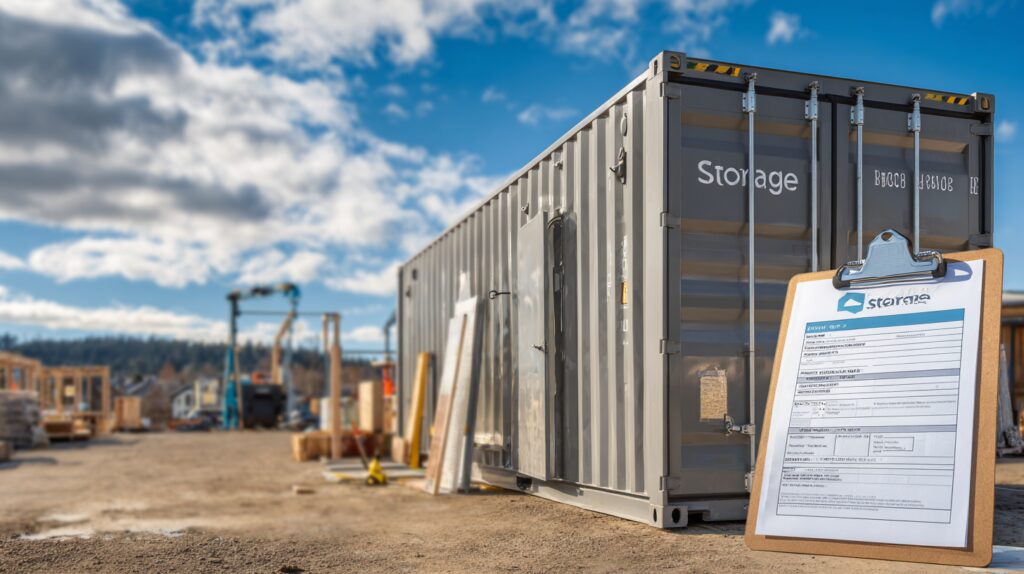
The federal tax code does not often hand small businesses an obvious win. But right now — and specifically for tax years 2025 and 2026 — it does. The combination of an expanded Section 179 deduction and fully restored 100% bonus depreciation, both made permanent by the One Big Beautiful Bill Act signed into law on July 4, 2025, means that contractors, tradespeople, landlords, and small-business owners who purchase qualifying equipment this year can write off the entire cost in the same tax year they put it to work.
A shipping container qualifies as tangible business property under those rules when it is used primarily for business purposes. That means the contractor who buys a steel storage unit for the jobsite rather than paying a storage yard month after month is not just solving a logistics problem. They may be making one of the smarter tax moves of the year — purchasing a depreciable asset instead of an operating expense with no residual value.
This article explains how those rules work in plain language, walks through real examples for contractors and small businesses, and lays out exactly when buying a container beats renting off-site storage or paying for space you will never own. As always, talk to your tax professional about your specific situation before making purchasing or filing decisions.
What Changed in 2025 — and Why It Matters Right Now
Before the One Big Beautiful Bill Act, the Section 179 deduction was capped at $1.25 million for 2025, with a phase-out beginning at $3.13 million in total qualifying equipment purchases. Bonus depreciation — the percentage of a qualifying asset’s cost that could be written off in the first year — had been declining since 2023 and was headed toward zero by 2027.
The new law changed both rules dramatically.
For tax year 2025, the Section 179 limit jumped to $2.5 million, with the phase-out threshold rising to $4 million. For 2026, those numbers adjust upward again to approximately $2.56 million and $4.09 million respectively, with annual inflation adjustments built in going forward. More significantly for most small and mid-size businesses, the One Big Beautiful Bill Act restored bonus depreciation to 100% for qualifying property placed in service after January 19, 2025. According to Section179.org, that combination of Section 179 plus 100% bonus depreciation means many businesses can now deduct up to the full cost of qualifying equipment purchases in the year they are made.
For a contractor buying a $5,000 or $8,000 or $15,000 shipping container and putting it to work on an active jobsite, those numbers mean the entire purchase could potentially reduce taxable business income in the current year — not over five or seven years of depreciation schedules.
How Shipping Containers Fit the Definition of Qualifying Property
Section 179 applies to tangible personal property purchased and placed in service for business use during the tax year. The IRS defines qualifying property broadly to include machinery, equipment, and other tangible assets used in an active trade or business. A portable shipping container that serves as on-site tool storage, material staging, or a mobile equipment hub falls within the category of tangible business equipment. In the same way a work truck, a generator, or a piece of construction machinery would.
The key conditions are straightforward:
The container must be used more than 50 percent of the time for business purposes. It must be placed in service — meaning purchased and actively used — during the tax year in which the deduction is claimed. New and used equipment both qualify, provided the asset is new to the purchasing business. And the deduction cannot exceed the business owner’s taxable income for the year, though any unused portion can be carried forward.
Bonus depreciation operates somewhat differently. Unlike Section 179, it is not capped by taxable income, which means it can be applied even in a year when the business shows a loss. According to U.S. Bank’s analysis of the One Big Beautiful Bill Act changes, the IRS requires businesses to apply Section 179 first and then use bonus depreciation for any remaining eligible cost basis. Used together, the two mechanisms can often zero out the taxable cost of a qualifying purchase entirely.
None of this eliminates the need for documentation. Maintaining purchase records, delivery confirmation, and evidence of business use is standard practice and essential if a deduction is ever questioned. Your accountant will want a paper trail that matches the container purchase to a specific business activity.
The Contractor Math: Owning vs. Paying a Storage Yard
Here is where the business case gets concrete.
Consider a small electrical contractor with a two-person crew running commercial and residential service calls across a two-county region. Right now, that contractor pays $200 a month for a 10-by-10 storage unit at a self-storage facility — a place to keep spare conduit, wire spools, junction hardware, and specialty tools between jobs. That is $2,400 a year in recurring storage expense. After five years, it is $12,000 spent with nothing to show for it. No asset. No resale value. No equity.
The alternative: purchase a 20-foot shipping container from Giant Lock Box, have it tilt-bed delivered to the property, and use it as a permanent tool and materials hub. A quality used unit typically runs in the range of $2,500 to $4,500 depending on condition and market. A one-trip unit in like-new condition runs higher, but still represents a one-time capital expenditure rather than a perpetual monthly drain.
Under current Section 179 rules, that purchase — assuming it meets the business-use threshold — may be fully deductible in the year of purchase. So the contractor is not just eliminating a $200/month line item. They are converting a recurring expense into a one-time equipment purchase that reduces taxable income today, while building an asset that can be resold, relocated, or repurposed years down the road.
For a contractor in a 25 percent effective tax bracket, a $4,000 container that qualifies for full Section 179 expensing represents roughly $1,000 in immediate federal tax savings. That brings the real after-tax cost of the container down to approximately $3,000 — and unlike a storage unit rental, the container retains value.
Larger contractors running multiple active projects stand to benefit even more. A roofing company or general contractor managing three or four simultaneous jobsites might purchase two or three 40-foot containers in a single tax year to handle tool staging, material storage, and on-site security. Under the 2025–2026 rules, each of those purchases may be expensed in full, and the combined deduction could meaningfully offset taxable business income for the year.
Why Ownership Beats Off-Site Self-Storage for Business Purposes
Self-storage is designed for personal use and priced accordingly. It is an operating expense — money paid for access to someone else’s space, with no ownership stake and no residual value at the end of the lease. For a homeowner storing seasonal items, that arrangement makes sense. For a business that needs regular, secure, on-demand access to tools and materials, the math is different.
A purchased container functions as a business asset in ways an off-site storage unit cannot:
It is on your property or jobsite, which eliminates the round-trip time cost of driving to and from a storage facility every time a crew needs equipment. For a two-person crew, even two or three of those trips per week adds up to significant lost productivity over the course of a year.
It is lockable, tamper-resistant, and built from corten steel — the same material used in ocean freight containers designed to withstand years of weather and handling. The security features of shipping containers include weather-tight seals, heavy-gauge steel walls, and standard hardware configurations that accept high-security lockbox systems. A storage unit at a public facility offers none of those protections at the same level.
It appreciates or holds value rather than generating zero equity. Used containers in good condition hold their value reasonably well, and a well-maintained unit can be resold when a business no longer needs it or when a project phase ends.
And critically, it may qualify for Section 179 treatment in the year of purchase — something a monthly storage rental never will.
Section 179 in Practice: A Few Scenarios
The solo landscaper. A sole proprietor running a landscaping and hardscaping business out of a one-acre property in New Jersey stores equipment in a rented shed that is aging and undersized. He purchases a 20-foot container for $3,800, has it delivered and placed at the corner of his property, and uses it exclusively to store commercial equipment. His accountant reviews the purchase, confirms the business-use threshold is met, and applies Section 179 to the full cost on his Schedule C. His federal taxable income drops by $3,800 for the year.
The mid-size remodeling contractor. A residential remodeling company with four crews and $2.1 million in annual revenue decides to formalize its jobsite storage strategy. It purchases two 40-foot containers and one 20-foot container over the course of the year, allocating them to the three largest active projects. Total equipment cost: approximately $22,000. The company’s CPA applies Section 179 to the full purchase value, reducing the firm’s taxable income by $22,000 for the year. After-tax cost of the containers at a 28 percent effective rate: approximately $15,840 — and the company now owns three durable assets it can redeploy across future projects indefinitely.
The small property management company. A landlord managing 12 rental units across two townships buys a 20-foot container to store maintenance supplies, seasonal equipment, and spare fixtures used exclusively for property upkeep. Her tax professional confirms that the container qualifies as business equipment under Section 179 given its exclusive business use and the active nature of her rental activities. The full purchase price is deducted in the year of purchase.
These examples are illustrations, not guarantees. The specifics of each situation — entity structure, income level, state tax conformity with federal Section 179 rules, and documented business use — determine the actual outcome. Every business owner should work through the numbers with a qualified CPA before making purchasing decisions based on anticipated deductions.
Choosing the Right Container for Your Business Use Case
Matching the container to the actual work is as important as understanding the tax treatment. A container that creates operational friction — wrong size, wrong access configuration, wrong placement — undermines the efficiency argument regardless of what it does for your tax return.
For contractors who need to pull equipment and materials quickly from both ends of a container without reshuffling the interior, double-door containers offer a significant workflow advantage. Loading from one end and accessing from the other keeps the unit organized even as inventory turns over frequently throughout a project.
For sites where side-loading access is a priority — think commercial sites with machinery, or properties where the container needs to be accessed laterally rather than end-on — open-sided containers provide full lateral access while retaining the standard door configuration at one end.
For businesses storing temperature-sensitive materials — adhesives, finishes, certain sealants, medications, or equipment with electronics — insulated containers maintain a more stable interior environment across seasonal temperature swings. On a Northeast jobsite in January or a Texas site in July, that protection matters both for materials and for the crew.
For businesses weighing size against footprint, the shipping container sizes guide walks through interior dimensions, volume capacity, and the practical differences between 20-foot and 40-foot units across various use cases. For businesses newer to container purchasing, what to look for when buying a shipping container covers condition grading, structural inspection points, and what questions to ask before committing to a unit.
It is also worth noting that both new and used containers qualify for Section 179 treatment, provided the unit is new to the purchasing business. The used shipping containers for sale options at Giant Lock Box represent a practical entry point for smaller businesses that want the asset ownership benefit without the premium of a one-trip unit.
Placement, Delivery, and Getting It on the Books
For Section 179 purposes, the asset must be placed in service during the tax year in which the deduction is claimed. According to the IRS guidelines on Form 4562, “placed in service” means the asset is available for and actively used in the business — not merely ordered or paid for, but physically delivered and operational.
Giant Lock Box’s tilt-bed delivery is built for precise placement on suitable, accessible ground. The container slides off the back of the bed and our drivers square it up exactly where you want it within the space the truck can safely reach. We walk the site before delivery so placement is planned out in advance — which matters on tight residential properties, commercial sites with limited staging area, and rural properties where access needs a careful look. If your site won’t work, we tell you before you pay.
The shipping container delivery and placement guide walks through site preparation, positioning logistics, and what to expect on delivery day. From a tax documentation standpoint, the delivery confirmation and placement date become part of the record that establishes the “placed in service” date — so keeping that paperwork organized from the start is worth the five minutes it takes.
When Renting Still Makes Sense
Ownership is not the right answer in every situation, and the tax argument for buying is strongest when the container will be in continuous business use for multiple years. For project-specific needs with a defined end date — a single renovation, a short-term construction phase, a seasonal spike in storage demand — renting a container keeps capital free and avoids the logistics of an asset that needs to be repositioned or resold at project close.
The advantages of storage container rental article compares the trade-offs between owned and rented units across different project durations and use cases. The short version: if the storage need is temporary and discrete, rent. If it is recurring, ongoing, and tied to the core operations of the business, the ownership math — especially with current Section 179 rules — tends to favor buying.
For contractors managing multiple projects simultaneously who want some of each, the combination approach works too: owned units at a home base or recurring-use site, rented units deployed project by project. That is a conversation worth having with both the Giant Lock Box team and your accountant.
The Tax-Savvy Container Buyer’s Checklist
Before closing on a container purchase with a Section 179 deduction in mind, work through these steps:
Confirm the container will be placed in service — delivered and actively used for business — before December 31 of the current tax year. Order early enough to account for delivery lead time.
Document the business use. Maintain a clear record of what the container stores, which business operation it supports, and that it meets the more-than-50-percent business use threshold. A simple log or written description is sufficient for most small businesses.
Check state conformity. Federal Section 179 rules do not automatically apply at the state level. Some states conform fully to federal Section 179; others cap the deduction at a lower amount or have different phase-out thresholds. Your CPA can confirm your state’s current position.
Apply Section 179 first, then bonus depreciation. IRS rules require this order. For most small business purchases in the $3,000–$20,000 range, Section 179 will cover the full cost. For larger purchases, bonus depreciation at 100% handles the remainder.
File Form 4562 with your return. This is the form used to claim Section 179 and bonus depreciation deductions. Your tax professional will handle this, but knowing it is required is useful context.
The Bottom Line
The 2025–2026 tax environment is genuinely favorable for businesses that purchase equipment and put it to work. The One Big Beautiful Bill Act did not create a loophole — it doubled existing incentives and made them permanent, which is a different thing. Section 179 has always rewarded businesses that invest in their own productive capacity rather than paying others for access to theirs.
A shipping container sits squarely in that framework. It is a tangible, durable, depreciable business asset that solves a real operational problem — secure, accessible, on-site storage — while potentially generating an immediate tax benefit in the year of purchase. The contractor who understands that owns better infrastructure, stops paying a storage yard every month, and may pay less in taxes this year than if they had done nothing.
If you are ready to explore what size and configuration fits your business, the team at Giant Lock Box can walk you through the options. Request a quote to get the conversation started — and bring the purchase details to your accountant before year-end while there is still time to put the asset in service.
For contractors already thinking about jobsite organization and efficiency as a competitive advantage, the article on shipping containers for jobsite storage and labor shortages covers the operational case for on-site container use in detail. The tax case and the efficiency case reinforce each other — and both point toward the same conclusion.