
If you’ve been thinking about buying a shipping container for jobsite storage, property overflow, or a long-term alternative to renting self-storage space, the market just tilted in your favor.
A wave of new vessel capacity is flooding the global shipping industry at the same time that U.S. container imports are declining. The result is a growing surplus of equipment—and for buyers on the ground in New York, New Jersey, Connecticut, Pennsylvania, and beyond, that surplus is translating into better availability, stable pricing, and a window to purchase that may not stay open indefinitely.
Here’s what’s happening in the container market in 2026, why it matters to anyone shopping for a shipping container, and how to take advantage of it.
The Global Overcapacity Problem Is a Local Buying Opportunity
The container shipping industry is entering what analysts describe as a cyclical downturn driven by structural overcapacity. According to Freightos, the global container fleet is growing significantly faster than cargo demand—with fleet capacity projected to expand roughly 3.6% to 5% this year while demand growth trails at just 1.5% to 3%. The current orderbook of new vessels exceeds 30% of the existing active fleet, the highest ratio since 2011.
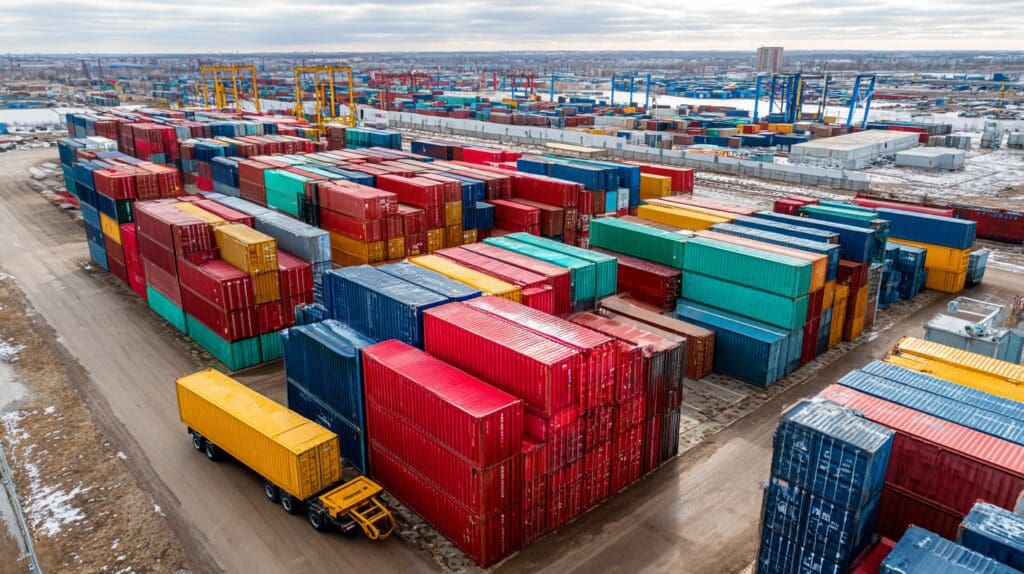
What does that mean in plain English? There are more containers in circulation than the shipping industry needs to move cargo. When carriers have surplus equipment, more units get offloaded into the domestic resale market—the same market where homeowners and contractors buy storage containers.
This dynamic has helped stabilize used container pricing across the United States through early 2026. Industry sources report good availability of used inventory nationwide, with projections for that supply to remain steady through at least mid-2026.
U.S. Import Declines Are Adding to the Surplus
The overcapacity isn’t just a global story. U.S. container import volumes are falling, which further increases the supply of containers available domestically.
The National Retail Federation (NRF) and Descartes Global both reported that January 2026 import volumes dropped compared to the prior year, with NRF projecting monthly volumes below two million TEU through April. For the first half of 2026, total retail imports are expected to decline about 2% from 2025 levels. Imports from China alone fell nearly 23% year-over-year in January.
Several factors are driving the slowdown. Much of 2025’s import activity was inflated by frontloading—importers rushing goods into the country ahead of anticipated tariff changes. That pull-forward demand has now largely played out, leaving 2026 with softer baseline volumes. Ongoing trade policy uncertainty is also making importers more cautious about placing large orders.
For anyone in the market for a 20-foot or 40-foot shipping container, the import decline means more equipment sitting at U.S. depots rather than cycling back overseas. More supply at depots generally means better selection and more competitive pricing for domestic buyers.
What This Means for Container Prices Right Now
Container pricing in 2026 has stabilized considerably compared to the extreme swings of the pandemic years. Used 20-foot containers in good condition are generally running between $1,200 and $2,800, while used 40-foot units range from roughly $1,800 to $3,500. New one-trip containers—units that have made a single voyage from the factory in China to a U.S. depot—run higher, typically $2,500 to $5,000 for a 20-foot and up to $7,000 for a 40-foot high-cube.
These prices reflect a market that has largely returned to pre-pandemic norms, which is a significant improvement for buyers who were priced out during the supply chain chaos of 2021 through 2023.
However, the stability comes with a caveat. Several forces could push prices upward later in the year. Tariffs on Chinese-manufactured goods—China produces approximately 85% of the world’s new containers—could increase new container costs by 20% to 30% if fully implemented. Seasonal demand typically accelerates starting in March as construction activity, agriculture, and summer moving season ramp up simultaneously. And if trade policy shifts trigger another round of import frontloading, the surplus of available equipment could tighten quickly.
The takeaway: early 2026 represents one of the better buying windows the market has offered in several years. Waiting may not cost you dramatically, but it’s unlikely to save you anything either.
Who Benefits Most from the Current Market
Contractors and Construction Companies
Jobsite storage demand runs year-round, but purchasing decisions often get deferred when pricing feels uncertain. The current environment removes that uncertainty. A contractor who buys a quality used 40-foot container now locks in a known cost for years of secure, weather-resistant tool and material storage—without monthly rental fees eating into project margins.
For contractors running multiple job sites, the math is especially compelling. A purchased container that moves from project to project eliminates repeated rental charges and the logistical headaches of coordinating third-party storage on tight timelines. With the 2026 labor shortage already pressuring margins, cutting unnecessary recurring costs wherever possible makes sense.
Homeowners Planning Renovations or Decluttering
If you’re converting your garage into a home office, finishing your basement, or simply trying to reclaim usable space in your home, the container supply glut works in your favor. Buying a container for on-property overflow storage is already more cost-effective than renting off-site self-storage over any period longer than about 18 months. In a market where used inventory is plentiful and pricing is stable, the value proposition only gets stronger.
A 20-foot container handles most residential storage overflows comfortably, while a 40-foot high-cube gives families clearing out an entire garage or basement enough room for everything—with the added ceiling height that makes stacking practical.
Small Businesses and Agricultural Operations
E-commerce businesses that need micro-warehouse space, landscaping companies with seasonal equipment, and farms that require weather-resistant storage for feed and tools all benefit from the same market dynamics. Buying a container during a period of good supply means better selection—including specialty units like insulated containers, refrigerated containers, and open-sided containers—and faster delivery timelines.
Why Buying Now May Beat Waiting
Market conditions are cyclical. The current glut won’t last forever. According to analyst forecasts reported by Xeneta, container demand growth of 3% against fleet growth of 3.6% will keep the market oversupplied through 2026, but several factors could shift the balance:
Tariff risk on new containers. With roughly 85% of new shipping containers manufactured in China, any escalation in trade restrictions could significantly increase the cost of new and one-trip units entering the U.S. market. Used containers would then become even more attractive—and potentially more expensive as demand shifts.
Seasonal tightening. Container demand in the U.S. follows a predictable seasonal curve. January and February are typically the softest months. By March and April, construction projects, agricultural operations, and summer moving activity all begin competing for the same inventory. If you’re reading this in early spring, the window is narrowing.
Geopolitical wildcards. Disruptions to global shipping routes—whether from Red Sea conflicts, port congestion, or trade policy shifts—can change equipment availability quickly. The surplus of today can become the shortage of next quarter with little warning.
For buyers who know they’ll need a container sometime this year, purchasing during a period of stable supply and competitive pricing reduces risk. You’re not speculating on a market dip—you’re acting on conditions that already favor you.
What to Look for When Buying in This Market
Good market conditions don’t eliminate the need for smart purchasing decisions. Here’s what to keep in mind:
Understand container grades. New or one-trip containers are in near-factory condition with clean interiors and smooth-operating doors. Used containers graded as “Wind and Water Tight” (WWT) are structurally sound and weather-sealed but show cosmetic wear from years of service. “Cargo Worthy” (CW) containers meet international shipping standards. For most storage applications, a quality used WWT unit delivers the best value.
Factor in delivery costs. The purchase price is only part of the total investment. Delivery and placement can add $300 to $2,500 or more depending on your distance from the nearest depot. Giant Lock Box’s tilt-bed delivery system places the container where the truck can safely reach it on suitable, accessible ground. We walk the site with you first, and if your spot won’t work, we’ll tell you before you pay.
Check local regulations. Container placement rules vary by municipality. Whether you’re in New York, New Jersey, Connecticut, Pennsylvania, Ohio, Rhode Island, or Texas, it’s worth understanding the local requirements before ordering. For New York buyers specifically, review the 2025–2026 container placement rules for your area.
Consider whether to buy or rent. If your storage need is temporary—during a renovation, for example—a container rental may be the most practical route. But if you anticipate needing secure storage for a year or more, the economics of buying almost always win. A purchased container eliminates monthly fees, retains resale value, and gives you 24/7 access to your belongings on your own property.
The Bottom Line
The global container shipping industry’s overcapacity problem is the storage buyer’s opportunity. More containers are available in the U.S. market than at any point since before the pandemic, pricing has returned to rational levels, and the inventory of quality used units is strong through at least mid-2026.
For contractors who need secure jobsite storage, homeowners looking for a permanent alternative to monthly self-storage fees, and small businesses that want durable on-property storage without building a permanent structure, the current market is as favorable as it’s been in years.
That window won’t stay open indefinitely. Tariff changes, seasonal demand, and geopolitical disruptions can all shift the equation. If you’ve been waiting for the right time to buy, the market is telling you it’s now.
Ready to lock in current pricing? Request a quote from Giant Lock Box or call (845) 343-0700 to discuss which container size and condition is right for your project.