

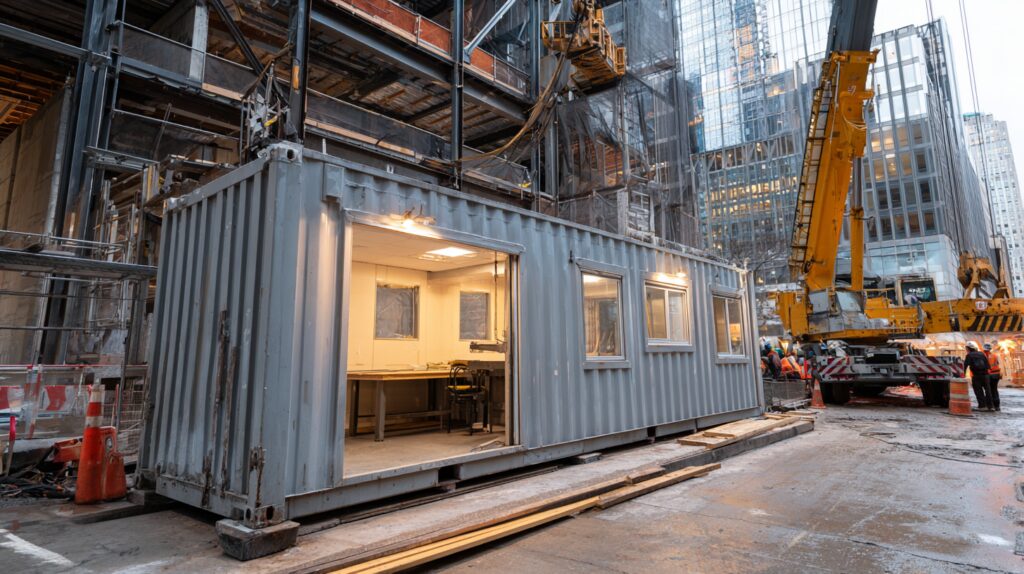
If you manage construction projects anywhere in New York—from high-rise foundations in Manhattan to residential developments on Long Island—you already know that a steel shipping container is one of the most secure ways to protect tools and materials on a jobsite. But a growing number of contractors across the state are discovering that the same 20-foot or 40-foot container they use for storage can also become a climate-controlled field office, a fully equipped workshop, or a mobile command center that follows their crew from project to project.
This shift is not theoretical. Container-based workspaces are showing up on commercial construction sites, utility corridors, infrastructure rehabs, and residential subdivisions throughout the five boroughs and beyond. The economics have never been more favorable: overcapacity in international shipping and a 6.8% decline in U.S. container imports in January 2026 have kept the secondary market for used containers well-stocked, and off-site fabrication means a finished workspace can be crane-delivered and operational within days rather than weeks.
This guide walks through the conversion types contractors are actually using, the practical advantages over traditional office trailers, and the considerations you need to think through before placing an order. Whether you need a one-person project manager's office or a multi-container command complex for a major build, the same steel box you already trust for secure jobsite storage can deliver far more value than you might expect.
Why Contractors Are Moving Beyond Trailers
For decades, the default on-site office for a New York construction project has been a towable trailer—a rectangular box on wheels, typically accessed by a set of metal stairs and a narrow landing. The trailer gets the job done, but contractors who have switched to modified shipping containers consistently point to the same set of frustrations that drove the change.
Ground-Level Access Eliminates Fall Hazards
Standard office trailers sit three to four feet off the ground, which means stairs, handrails, and a landing platform at the entry. That configuration triggers OSHA fall-protection requirements, creates slip-and-trip exposure in wet or icy conditions, and adds a compliance checkpoint that site safety managers have to monitor. A shipping container sits directly on the ground or on a set of low blocking pads. The entry threshold is at grade level or just a few inches above it, which removes the stair hazard entirely. For New York jobsites where winter conditions can turn metal stairs into skating rinks, ground-level access is not a minor convenience—it is a material reduction in liability.
Steel Construction Outperforms Vinyl and Aluminum
Office trailers are built with lightweight framing, vinyl or aluminum siding, and residential-grade doors and windows. They are designed to be light enough to tow, not to resist forced entry. A shipping container is made from 14-gauge corrugated Corten steel, originally engineered to survive years of ocean transport, stacking loads of 60,000 pounds, and exposure to salt spray. That structural DNA translates directly to jobsite security. Contractors storing expensive laptops, survey equipment, project plans, and sensitive documents inside a converted container office have a level of protection that no trailer can match.
Crane Placement Opens Inaccessible Sites
One of the most practical advantages—and one that Giant Lock Box customers already understand—is the ability to position a container with a crane truck. Trailers need road access and enough room to maneuver a tow vehicle. Containers can be lifted over fences, dropped into excavated sites, placed on slopes, or set down in tight interior courtyards where no truck could reach. On a dense New York City construction site, where every square foot of staging area is contested, crane placement lets you put your office exactly where your team works rather than wherever the trailer happens to fit.
Longevity and Resale Value
A well-maintained shipping container has a useful life measured in decades, and a modified container retains meaningful resale value because the steel shell remains structurally sound long after the interior finish has been updated. Office trailers depreciate quickly, often develop leaks at seams and window openings, and eventually reach a point where repair costs exceed replacement costs. Contractors who invest in a container conversion are building an asset, not renting a depreciating commodity.
Four Conversion Types That Work on Construction Sites
Not every container conversion needs to be a finished office with drywall and recessed lighting. The right build-out depends on your crew size, the type of work you do, and how often the unit needs to move. Here are the four configurations that New York contractors are putting to use right now.
1. The Modular Field Office
This is the direct replacement for a traditional office trailer. A standard 20-foot container provides roughly 160 square feet of interior space—enough for two to four workstations, a plan table, and a small meeting area. A 40-foot container opens that up to 320 square feet and can comfortably serve a team of six to eight. Typical modifications include spray-foam insulation rated for New York winters, a mini-split HVAC system, LED panel lighting, a 200-amp electrical panel with interior outlets and USB charging, vinyl plank or commercial-grade flooring, and one or two commercial entry doors with windows. Many contractors also add a fold-down exterior awning to create a covered check-in area for subcontractors and deliveries.
Best for: General contractors, project managers, site superintendents who need a secure, climate-controlled workspace without relying on trailer rental companies.
2. The Workshop and Fabrication Space
Containers converted into workshops are appearing on sites where crews need to cut, weld, assemble, or repair components without tying up the main work area. The steel shell provides natural fire resistance and sound containment that wood-framed structures cannot. Common workshop modifications include epoxy-coated floors for durability and easy cleaning, overhead LED shop lighting on 240-volt circuits, ventilation fans and dust-collection hookups, wall-mounted tool storage panels and magnetic strips, a roll-up cargo door on one end for moving large materials in and out, and a workbench with integrated vise and power outlets.
Best for: Mechanical contractors, HVAC installers, electrical shops, and any crew that does on-site fabrication or equipment repair.
3. The Hybrid Work-and-Store Unit
This is the configuration that makes the most sense for contractors who need both an office and a secure storage area but do not have the site space—or the budget—for two separate units. A 40-foot container is divided with an interior partition wall, typically allocating 25 feet (7.62 meters) to the finished office space and 15 feet (4.57 meters) to a locked cargo area accessible through the original container doors. The office side gets the full treatment: insulation, HVAC, lighting, electrical, and finish flooring. The storage side stays raw or gets a simple epoxy floor, with shelving or racking installed as needed.
The partition wall is typically steel-framed and insulated, with a lockable interior door so the project manager can access stored materials without going outside. This configuration is especially popular on smaller residential and commercial projects in the outer boroughs where staging space is at a premium.
Best for: Small to mid-size contractors running one or two active projects who need to consolidate their office and tool storage into a single, secure unit.
4. The Multi-Container Command Center
For large-scale infrastructure projects, commercial high-rises, or multi-phase developments, a single container is not enough. Multi-container configurations use two or more units placed side by side or stacked to create larger workspaces. A common setup is two 40-foot containers placed parallel with a shared interior wall removed to create a 640-square-foot open office, conference room, and plan review space. Two-story configurations—with an exterior staircase and upper-level containers used for management offices or meeting rooms—are increasingly common on major New York City projects where horizontal footprint is limited.
These complexes can include dedicated IT closets, server cooling, restroom pods, break rooms, and exterior-mounted security cameras. Because each unit is a self-contained module, the complex can be disassembled and reassembled at the next project site without losing any of the interior build-out.
Best for: Large general contractors, construction management firms, and owners managing multi-year projects with crews of 15 or more.
Quick Comparison: Container Office vs. Office Trailer
Ground-level access, all-steel security, crane placement flexibility, and decades-long durability—container offices address the four biggest complaints contractors have about traditional trailers. The table below summarizes the key differences.
| Feature | Container Office | Office Trailer |
|---|---|---|
| Entry Access | Ground level (ADA-friendly) | Stairs required (3–4 ft elevated) |
| Security | 14-gauge Corten steel | Vinyl/aluminum siding |
| Placement | Crane to any accessible point | Road access + tow vehicle |
| Setup Time | Hours (crane delivery) | Hours (but site access limits placement) |
| HVAC | Mini-split or ducted (custom) | Pre-installed (limited options) |
| Lifespan | 25–30+ years | 10–15 years typical |
| Theft Resistance | Excellent (lockbox + steel) | Moderate (residential-grade locks) |
| Resale Value | High (steel shell retains value) | Low (rapid depreciation) |
The 2026 Market Window: Why Now Is the Right Time to Source
Timing matters when you are buying a shipping container for conversion, and the current market conditions are working in contractors' favor. Several factors are converging in early 2026 that make this a particularly good window to source containers.
International shipping lines are dealing with overcapacity after the record-high import volumes of 2025. U.S. container imports dropped 6.8% in January 2026 compared to the previous year's peak, and tariff uncertainty continues to depress inbound volumes. That means more empty containers sitting at ports and depots across the Northeast, which keeps prices on the secondary market competitive. For contractors, this translates to better selection and more room to negotiate on pricing for both one-trip and cargo-worthy units.
At the same time, the New York City construction outlook remains strong through 2027, with $219 billion in total construction spending forecast across the three-year period and employment projected at 140,000 jobs in both 2026 and 2027. Contractors who secure workspace solutions now—while container supply is favorable—position themselves to handle increased project loads without scrambling for overpriced trailer rentals during peak construction season.
Planning Your Conversion: What Contractors Need to Know
Start With the Right Container Grade
Not every used container is suitable for conversion into a workspace. For office and workshop builds, you want a unit graded "one-trip" (used for a single ocean voyage and essentially new) or "cargo-worthy" (structurally sound, watertight, and certified for transport). Containers graded "wind and watertight" may have cosmetic damage or minor repairs that are fine for basic storage but could complicate a finished build-out. Avoid "as-is" containers for any conversion that involves insulation and interior finish, since hidden corrosion or floor damage can add significant cost once the build is underway. Giant Lock Box's team can help you evaluate container condition and pricing before you commit.
Insulation Is Non-Negotiable in New York
Steel is an excellent conductor of heat, which means an uninsulated container will be unbearable in a New York summer and dangerously cold in winter. Closed-cell spray foam is the standard insulation method for container conversions because it adheres directly to the corrugated walls, provides both thermal and moisture barrier in a single application, and does not require a separate vapor barrier. Two inches of closed-cell spray foam delivers approximately R-13, which is sufficient for most three-season use. For year-round offices in upstate New York or on exposed waterfront sites, three inches (approximately R-20) is a better investment. If you need a container that arrives with insulation already in place, Giant Lock Box also carries insulated containers as a starting point for conversion projects.
Electrical and HVAC: Size for Your Actual Use
One of the most common mistakes in container conversions is undersizing the electrical panel. A single-person office with a laptop and LED lights can run on a 60-amp subpanel. A four-person office with a copier, coffee maker, space heaters as backup, and multiple monitors needs a 200-amp panel and a dedicated circuit for the HVAC system. For workshops, 240-volt circuits for welders, compressors, or table saws should be planned from the start, not added after the fact. Mini-split HVAC systems are the standard for container offices because they provide both heating and cooling, mount with minimal penetration through the container wall, and operate quietly enough for office use.
Permitting and Zoning: Know Before You Order
In New York City, a container placed on a construction site as a temporary office generally falls under the same permitting framework as a construction trailer—the Department of Buildings treats it as a temporary structure associated with an active building permit. Outside the city, zoning rules vary widely by municipality. Some towns in the Hudson Valley and on Long Island have specific restrictions on shipping containers, while others treat them the same as any accessory structure. The key step is to check with your local building department before you order a conversion, not after the container is sitting on your site.
For permanent or semi-permanent placements—such as a container workshop at your company yard—you may need a building permit, a site plan, and compliance with setback and lot-coverage requirements. A modified container with electrical, plumbing, and HVAC typically requires inspections just like any other occupied structure.
Foundation and Site Preparation
A shipping container does not need a poured foundation for temporary jobsite use. Four level pads—concrete blocks, compacted gravel pads, or treated timber cribbing—at the corner castings are sufficient for most placements. For permanent installations, a concrete pier or strip footing system provides better long-term stability and keeps the container elevated enough for airflow underneath, which prevents moisture accumulation on the underside of the steel floor.
Cost Expectations: What the Numbers Actually Look Like
Container conversion costs vary widely depending on the level of finish, but contractors consistently find that the all-in cost comes in 30–50% below a comparable permanent structure and competes favorably with long-term trailer rental costs. Here is a general framework for budgeting.
| Configuration | Container + Mods | Comparable Trailer Rental (2 yrs) |
|---|---|---|
| 20' Basic Office (1–2 person) | $15,000–$25,000 | $18,000–$28,000 |
| 40' Full Office (4–8 person) | $30,000–$50,000 | $36,000–$55,000 |
| 40' Workshop Build-Out | $20,000–$40,000 | N/A (limited rental options) |
| 40' Hybrid Office + Storage | $25,000–$45,000 | $30,000–$48,000 |
| Multi-Container Complex (2–4 units) | $80,000–$150,000+ | $72,000–$130,000+ |
Note: Costs are approximate ranges for the New York metro area as of early 2026. Delivery, crane placement, and site prep are typically additional. Trailer rental estimates assume standard commercial lease rates for comparable square footage over a 24-month term.
The cost advantage of container conversions becomes more pronounced on longer projects. A trailer rental is a pure expense—you pay monthly, and when the project ends, you return the trailer with nothing to show for it. A container conversion is a capital asset that you own, can redeploy to your next project, and can eventually sell on the secondary market.
How Giant Lock Box Fits Into This Picture
If you have worked with Giant Lock Box before, you already know the company's core capability: delivering secure steel containers to jobsites across New York with crane trucks that can place units precisely where you need them—on tight lots, behind existing structures, on uneven ground, and in locations that tow-behind trailers simply cannot reach.
That same delivery and placement infrastructure is exactly what makes container workspace conversions practical. The container arrives on a flatbed, the crane lifts it into position, and your crew is working inside the same day. There is no foundation pour to schedule, no waiting for a trailer company to find an opening, and no compromising on placement because a tow truck cannot navigate your site.
Whether you are starting with a standard container and working with a local fabricator to complete the conversion, or you are sourcing a pre-modified unit, Giant Lock Box can help you get the right container to the right spot. The company's team can also help you think through sizing, condition grading, and placement logistics—the same expertise that has made them a trusted partner for construction storage across the New York metro area. Contractors who want to explore renting a container before committing to a purchase can also discuss short-term and long-term rental options.
Getting Started: A Practical Checklist
Before you pick up the phone, work through these items so you can have a productive conversation with your container supplier and your conversion fabricator.
- Define your primary use. Office only? Workshop? Hybrid? Multi-container complex? This determines container size, electrical requirements, and insulation specs.
- Count your people. A 20-foot container comfortably serves one to four people. A 40-foot container handles four to eight. Anything larger requires multi-container configurations.
- Assess your site. Measure the available footprint, confirm that the location is accessible by flatbed and crane, and check ground conditions for level blocking or pad placement.
- Check local permitting. Confirm with your building department whether a container office on an active construction site requires a separate permit or falls under your existing building permit.
- Choose your container grade. One-trip for premium builds, cargo-worthy for standard office and workshop conversions. Inspect before purchasing if possible.
- Budget for the full scope. Container purchase, conversion fabrication, delivery and crane placement, electrical hookup, and any site prep (gravel pad, utility run, etc.).
- Plan for relocation. If the container will move between projects, make sure your conversion fabricator designs for transport—securing interior fixtures, reinforcing any cut openings, and maintaining fork pockets and corner castings.
The Bottom Line
The shipping container on your job site does not have to be just a locked box for storing tools. With the right modifications, that same steel structure becomes a secure, durable, ground-level workspace that outperforms traditional trailers on safety, security, longevity, and total cost of ownership. The 2026 container market gives New York contractors a favorable window to source quality units at competitive prices, and the modular nature of container construction means your workspace investment moves with you from project to project for years to come.
Giant Lock Box has been helping New York contractors get the right container to the right spot for years. If you are ready to think beyond storage, reach out to the team to discuss container options, sizing, delivery logistics, and placement for your next project.
Ready to Explore Container Workspaces?
Contact Giant Lock Box to discuss container options for your next project. Whether you need a basic storage unit, a finished field office, or a multi-container complex, the team can help you choose the right size, grade, and placement strategy for your site. Request a quote or call (845) 343-0700 to get started.
Disclaimer: Cost estimates, market data, and regulatory references in this article are provided for general informational purposes and may vary based on location, project specifics, and market conditions. Always verify current pricing, permitting requirements, and zoning regulations with qualified professionals and local authorities before making purchasing decisions.